What if AI could help you understand money, find better financial opportunities, and build wealth faster?
Artificial Intelligence is no longer just a technology for the future. It is already changing how banks manage money, how investors analyze markets, and how ordinary people plan their finances.
But here is the important question:
Can AI actually help you become a millionaire—or is that just another internet promise?
In this guide, we will explore how AI is changing finance, where it can genuinely help you build wealth, and where you need to be careful.
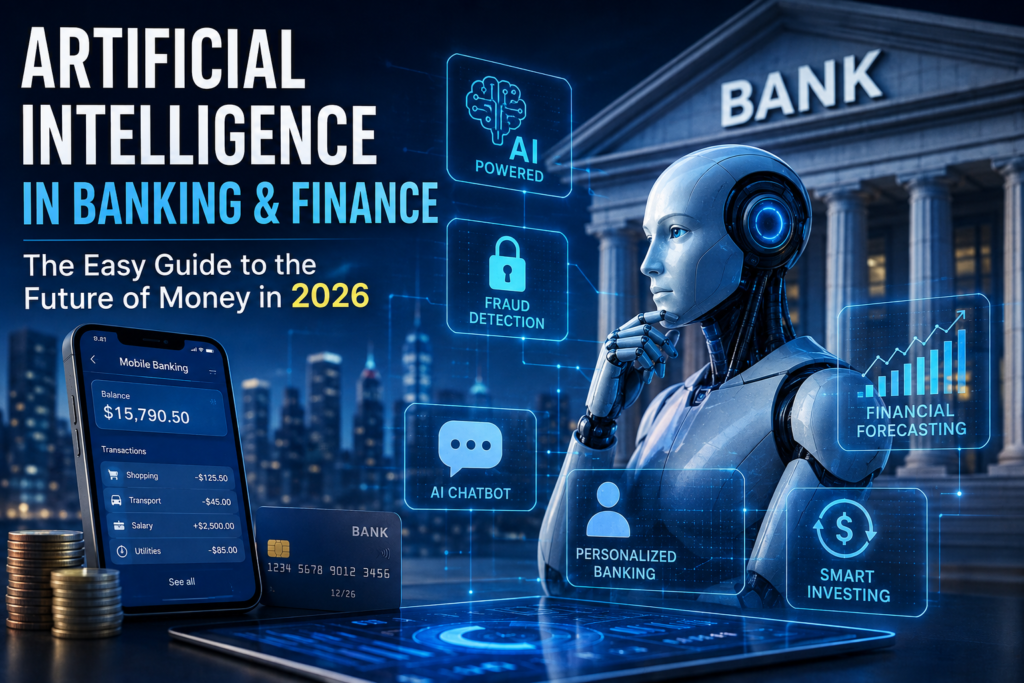
Artificial Intelligence (AI) is no longer just a technology used by big technology companies. In 2026, AI is becoming an important part of banking, personal finance, lending, payments, investing, fraud detection, and financial services.
From checking suspicious transactions to helping banks understand customer behavior, AI is changing how money moves and how financial decisions are made.
But what does AI actually mean for ordinary people?
Will AI make banking easier? Can it help people manage their money better? Will AI replace financial advisors and bank employees? And what risks should consumers know before trusting AI with their financial information?
This easy guide explains how Artificial Intelligence is changing banking and finance in 2026, what the technology can do, where it is being used, and what the future may look like.
What Is Artificial Intelligence in Finance?
Artificial Intelligence in finance means using computer systems that can analyze large amounts of financial information, recognize patterns, make predictions, understand language, and automate certain financial tasks.
Traditional software usually follows instructions written by humans.AI can go further. It can analyze data, identify patterns, and provide recommendations or take specific actions based on the information it receives.For example, a bank may use AI to analyze thousands of transactions and identify unusual behavior that could indicate fraud.
A lender may use AI to analyze financial information when assessing credit risk.A financial app may use AI to categorize expenses and help a customer understand where their money is going.
This is why AI is becoming increasingly important in modern financial services. Research from the Cambridge Centre for Alternative Finance shows that financial institutions are already using AI heavily for process automation, customer support, fraud detection, credit risk modeling, and other operational tasks.
1. AI Is Making Banking More Automated
One of the biggest changes AI is bringing to banking is automation.
Banks process enormous amounts of information every day. Traditionally, many of these tasks required employees to manually review documents, transactions, customer requests, and financial records.
AI can automate many repetitive activities.
For example, AI can help banks:
- Review financial documents
- Verify customer information
- Detect unusual transactions
- Answer common customer questions
- Analyze loan applications
- Monitor compliance requirements
- Summarize financial reports
- Organize customer information
This does not mean that every banking decision will be made by a machine.
Instead, AI is increasingly being used to handle repetitive and data-heavy work while human employees focus on more complicated decisions.
2. AI and Fraud Detection
Fraud detection is one of the most important applications of AI in banking.
Every day, banks and payment companies process millions of transactions. Some transactions are legitimate, while others may involve stolen cards, account takeovers, identity theft, or other forms of financial fraud.
Traditional fraud detection systems often rely heavily on predefined rules.
AI can analyze many variables at the same time.For example, an AI system may consider:
- Transaction amount
- Location
- Device information
- Time of transaction
- Previous spending behavior
- Merchant information
- Login behavior
- Account activity
If a transaction looks very different from a customer’s normal behavior, the system can flag it for additional review.
AI-powered fraud detection can operate much faster than manual review, making it particularly useful in digital banking and real-time payments.
Example
Imagine someone normally spends $20–$100 on everyday purchases.
Suddenly, a large transaction appears from a new device in another country.
An AI system may recognize that this behavior is unusual and trigger additional security checks.
The goal is not simply to block transactions.
The goal is to identify suspicious behavior while reducing unnecessary false alarms.
3. AI Is Changing Credit and Loan Decisions
Getting a loan traditionally involves collecting financial information, checking credit history, reviewing documents, and assessing the applicant’s ability to repay.
AI can make parts of this process faster.
AI systems can analyze financial information and identify patterns related to credit risk.
Banks and lenders can potentially use AI to:
- Analyze loan applications
- Verify documents
- Detect suspicious applications
- Estimate credit risk
- Automate parts of underwriting
- Identify customers who may qualify for financial products
This could make lending faster and potentially expand access to financial services.
However, credit decisions are highly sensitive.
If an AI system is trained on biased or incomplete data, it could produce unfair outcomes.
That is why human oversight, explainability, data quality, and regulatory compliance are extremely important when AI is used for lending.
4. AI Can Help You Understand Your Spending
AI is not only useful for banks.
It can also change how individuals manage their personal finances.
Modern financial apps can use AI to categorize transactions and identify spending patterns.
For example, AI may recognize that you are spending:
- $300 on food
- $150 on transportation
- $500 on shopping
- $100 on subscriptions
Instead of simply showing transactions, an AI-powered financial tool can turn this information into useful insights.
It might tell you:”You spent more on online shopping this month than last month.”
This type of information can help people become more aware of their financial behavior.
5. AI-Powered Financial Forecasting
One of the most interesting applications of AI in finance is forecasting.
Financial forecasting means trying to estimate what could happen in the future based on available information.
AI can analyze historical and current data to identify patterns.
For individuals, AI could potentially help estimate:
- Future cash flow
- Monthly expenses
- Savings progress
- Debt repayment timelines
- Emergency fund requirements
The Future of Money Is Becoming Intelligent
Artificial Intelligence is changing finance from a system that mainly reacts to customer requests into a system that can increasingly predict, monitor, personalize, and automate financial activities.
In 2026, the transformation is already visible across fraud detection, lending, customer service, compliance, financial forecasting, and financial operations.
The next stage could be even more significant.AI agents may perform multi-step financial workflows.
Personal financial assistants may help consumers understand their entire financial lives.Banks may use AI to identify risks before they become major problems.
Financial services may become more personalized and increasingly embedded into everyday digital experiences.
But technology alone will not determine whether this future is successful.
Trust, privacy, security, transparency, regulation, and human oversight will be equally important.The future of finance is therefore not simply AI replacing humans.
It is more likely to be humans using intelligent financial technology to make better and faster decisions.
The Rise of Agentic AI in Banking
One of the major AI developments in 2026 is the growth of agentic AI.
Traditional AI often responds to a question or performs one specific task.
Agentic AI is designed to work through multiple steps toward a goal.
For example, instead of simply telling a bank employee that a customer has submitted a loan application, an AI agent could potentially help collect documents, verify information, check predefined requirements, summarize the application, and send it to the appropriate human reviewer.
Financial institutions are increasingly exploring agentic AI for customer service, compliance, fraud investigation, and operational workflows.
This could make banking operations faster.But it also increases the importance of controls. The more authority an AI system receives, the more important it becomes to have access controls, audit trails, human oversight, and clear rules about what the AI is allowed to do.
Will AI Replace Bank Employees?
Probably not completely.
AI will replace some repetitive tasks, but banking still requires human judgment.
People are needed for:
- Complex financial decisions
- Customer relationships
- Strategic planning
- Ethical decisions
- Regulatory judgment
- Handling unusual cases
- Managing financial risk
The more realistic future is human + AI, rather than AI replacing every person.
AI may handle large amounts of repetitive information while humans focus on decisions that require experience, judgment, empathy, and responsibility.
Artificial Intelligence (AI) Guide 2026 | Future of Smart Technology
Learn how Artificial Intelligence (AI) is changing the world in 2026. Discover AI uses, benefits, future trends, industries affected by AI, and simple answers to common AI questions.
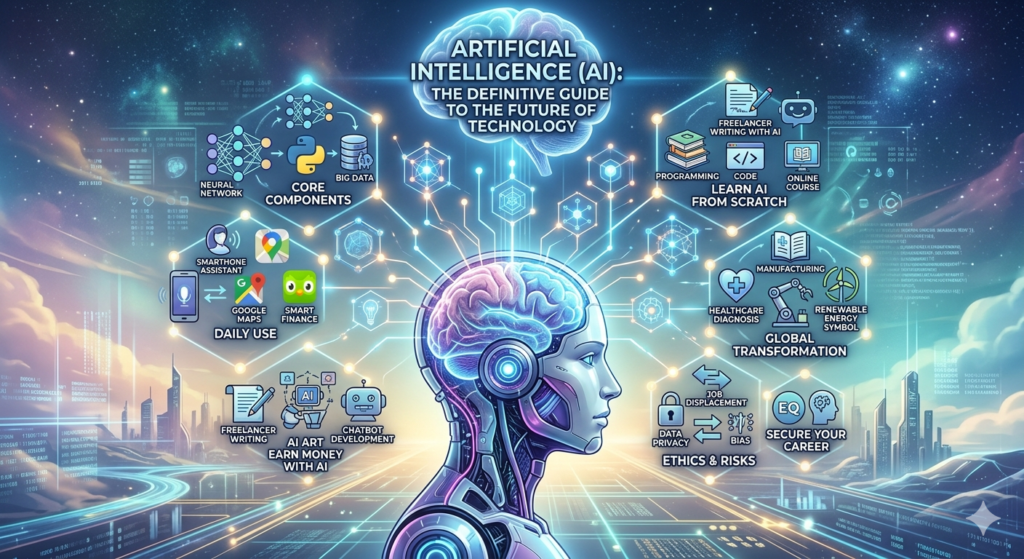
Artificial Intelligence (AI) has transitioned from the realm of science fiction into the backbone of modern civilization. It is no longer just about robots with human-like features; it is about the invisible algorithms that power our world, from the way we shop to the way doctors diagnose life-threatening diseases.
In this comprehensive guide, we will explore the depths of AI, its practical applications, and how you can navigate this rapidly evolving landscape.
What Exactly is Artificial Intelligence?
At its simplest level, Artificial Intelligence is the simulation of human intelligence processes by machines, especially computer systems. These processes include learning (the acquisition of information and rules for using it), reasoning (using rules to reach approximate or definite conclusions), and self-correction.
The Three Stages of AI Evolution
- 1. Artificial Narrow Intelligence (ANI): Also known as “Weak AI,” this is the AI we use today. It is programmed to perform a single task—like facial recognition or internet searches.
- 2. Artificial General Intelligence (AGI): This refers to a machine that has the capacity to understand or learn any intellectual task that a human being can. We have not yet reached this stage.
- 3. Artificial Super Intelligence (ASI): This is a hypothetical level of AI that surpasses human intelligence across all fields, including scientific creativity, general wisdom, and social skills.
How to Understand the Core Components of AI?
To truly grasp how AI works, we must look at the “engine” under the hood. AI isn’t just one technology; it’s a collection of several sub-fields.
1. Machine Learning (ML)
Machine Learning is the most common form of AI. It involves training an algorithm on a massive dataset so it can learn how to make predictions or decisions without being explicitly programmed for every scenario.
2. Deep Learning and Neural Networks
Inspired by the structure of the human brain, neural networks consist of layers of interconnected nodes. Deep learning is a subset of ML that uses many layers of these networks to solve complex problems like speech recognition and image synthesis.
3. Natural Language Processing (NLP)
NLP is what allows machines to read, understand, and derive meaning from human languages. This is the technology behind chatbots like Gemini and translation tools like Google Translate.
4. Computer Vision
This field enables computers to “see” and interpret visual information from the world, such as identifying objects in a photo or navigating a self-driving car through traffic.
How to Use AI in Your Daily Life?
You might be surprised at how much you already rely on AI. Understanding how to use it effectively can save you hours of work and improve your quality of life.
- Productivity:Tools like AI-powered grammar checkers (Grammarly) or meeting transcribers (Otter.ai) help you communicate more clearly and keep track of information.
- Smart Finance: Many banking apps use AI to track your spending habits, provide budget advice, and alert you to potential fraudulent activity.
- Healthcare at Home: Wearable devices like smartwatches use AI to monitor your heart rate, sleep patterns, and even detect falls, providing data that can be shared with medical professionals.
- Personalized Learning: Language apps like Duolingo use AI to adapt lessons based on your performance, ensuring you spend more time on words you find difficult.
How to Earn Money Using AI?
The AI revolution is creating a “Gold Rush” of opportunities for entrepreneurs, freelancers, and students. Here is how you can capitalize on it:
1. AI-Assisted Freelancing
If you are a writer, designer, or coder, AI can be your co-pilot. Writers use AI for brainstorming and outlining; designers use it for generating base assets; coders use it to debug or generate boilerplate code. This allows you to finish projects 3x faster, meaning you can take on more clients.
2. Building AI-Driven Content Niches
You can start a YouTube channel or a blog where the research, scriptwriting, and even the voiceover are handled or assisted by AI tools. By focusing on trending niches, you can build an audience and monetize through ads and sponsorships.
3. AI Consulting for Small Businesses
Many small businesses know they need AI but don’t know where to start. You can offer services to help them integrate AI chatbots for customer service or automate their email marketing, charging a premium for your expertise.
How to Learn AI From Scratch?
You don’t need a PhD in Mathematics to get started with AI. The barrier to entry has never been lower.
- Step 1: Master the Basics of Data: Understand what data is and how it’s collected. AI is only as good as the data it’s fed.
- Step 2: Learn Python: Python is the “language of AI.” It is beginner-friendly and has extensive libraries (like TensorFlow and PyTorch) specifically for AI development.
- Step 3: Take Online Courses: Platforms like Coursera, edX, and YouTube offer free and paid certifications from top universities like Stanford and MIT.
- Step 4: Build a Portfolio: Start small. Create a basic sentiment analysis tool or a simple image classifier. Real-world projects are more valuable than certificates.
How AI is Transforming Global Industries?
Healthcare
AI is revolutionizing medicine by predicting outbreaks of diseases, accelerating drug discovery, and assisting in robotic surgeries. In radiology, AI algorithms can spot tumors that might be invisible to the human eye.
Environment and Sustainability
AI is being used to track deforestation via satellite imagery, optimize energy grids to reduce waste, and design new materials for more efficient solar panels.
Manufacturing and Logistics
From “cobots” (collaborative robots) working alongside humans on assembly lines to AI-driven supply chain management that predicts shipping delays before they happen, the industrial sector is becoming smarter and leaner.
How to Address the Risks and Ethics of AI?
- Job Displacement: While AI creates new roles, it also automates traditional ones. The key is “reskilling”—training the workforce to work with AI rather than competing against it.
- Algorithmic Bias: If the data used to train AI contains human biases, the AI will replicate them. This can lead to unfair treatment in hiring, lending, or law enforcement.
- Privacy Concerns: AI requires vast amounts of data. Ensuring this data is used ethically and that individuals’ privacy is protected is a major concern for governments worldwide.
How to Secure Your Career Against AI Automation?
The best way to stay relevant in an AI-driven world is to focus on Human-Centric Skills. These are things AI cannot replicate (yet):
- Critical Thinking: AI can provide facts, but humans must provide the “Why” and make final ethical judgments.
- Emotional Intelligence (EQ): Empathy, negotiation, and building deep human relationships are skills that machines lack.
- Creative Strategy: AI can generate a thousand logos, but it cannot understand the deep cultural context or “soul” of a brand.
Conclusion: Embracing the AI Era
Artificial Intelligence is not a replacement for human potential; it is an amplifier. Just as the steam engine amplified our physical strength and the internet amplified our reach, AI is amplifying our cognitive abilities.
The future belongs to those who view AI as a partner. By learning how to use these tools responsibly, creatively, and strategically, you can unlock opportunities that were previously unimaginable. We are standing at the beginning of a new chapter in human history—one where the only limit is our imagination.
What is the first AI tool you plan to master to help you in your career or personal projects?
Artificial Intelligence (AI) is one of the fastest-growing technologies in the world. It helps machines think, learn, and make decisions like humans. In 2026, AI is becoming an important part of daily life and changing industries such as healthcare, education, business, and transportation.
AI Comparison Table
| Feature | Traditional Technology | Artificial Intelligence (AI) |
|---|---|---|
| Working Style | Manual instructions | Smart automated learning |
| Decision Making | Human-based | Data-driven decisions |
| Speed | Normal processing | Faster processing |
| Accuracy | Depends on humans | High accuracy |
| Learning Ability | Cannot learn | Learns from data |
| Automation | Limited | Advanced automation |
| Customer Support | Human agents | AI chatbots |
| Healthcare Support | Manual diagnosis | AI-powered diagnosis |
| Data Analysis | Slow | Real-time analysis |
| Future Growth | Limited | Very high potential |
FAQ Question
1. What is Artificial Intelligence (AI)?
Artificial Intelligence (AI) is smart computer technology that can think, learn, and solve problems like humans.
2. How is AI used in daily life?
AI is used in mobile phones, online shopping, voice assistants, healthcare, social media, and self-driving technology.
3. Is AI good for the future?
Yes, AI can improve healthcare, education, business, and productivity while saving time and reducing human effort.
4. Can AI replace human jobs?
AI may replace some repetitive jobs, but it will also create new career opportunities in technology and digital industries.
5. Which industries use AI the most?
Healthcare, banking, education, transportation, marketing, and manufacturing use AI heavily.
6. Is AI safe for humans?
AI is safe when used responsibly with proper rules, security, and human control.
7. What are the benefits of AI?
AI helps increase speed, accuracy, automation, and decision-making in many industries.
What is AI in banking?
AI in banking is the use of artificial intelligence to analyze financial data, detect patterns, automate processes, improve customer service, assess risk, detect fraud, and support financial decisions.
How is AI used in finance in 2026?
AI is being used for fraud detection, credit risk assessment, customer service, financial forecasting, compliance, document processing, personalization, investment analysis, and operational automation.
Can AI help me manage my money?
Yes. AI-powered financial tools can help categorize expenses, identify spending patterns, create financial insights, and explain financial concepts. However, important financial decisions should be verified.
Can AI predict the stock market?
No AI can reliably predict the stock market with certainty. AI can analyze historical and current information, but investments remain subject to uncertainty and risk.
Will AI replace bankers?
AI may automate many repetitive banking tasks, but human employees will continue to be important for complex decisions, customer relationships, strategy, compliance, and financial judgment.
Is AI safe for banking?
AI can improve banking security, especially in fraud detection, but it also creates privacy, cybersecurity, bias, and governance risks. Banks need strong controls and human oversight.
Final Thoughts
Artificial Intelligence is becoming one of the most important technologies shaping the future of banking and finance.
The biggest opportunity is not simply automation.
It is the ability to turn massive amounts of financial data into useful information, faster decisions, stronger security, and more personalized financial services.
For consumers, the most important lesson is simple:
AI can become a powerful financial tool, but it should be used as an assistant—not as a replacement for financial judgment.
As AI becomes more deeply integrated into banking, the people who understand both money and technology will be better prepared for the financial world of the future.