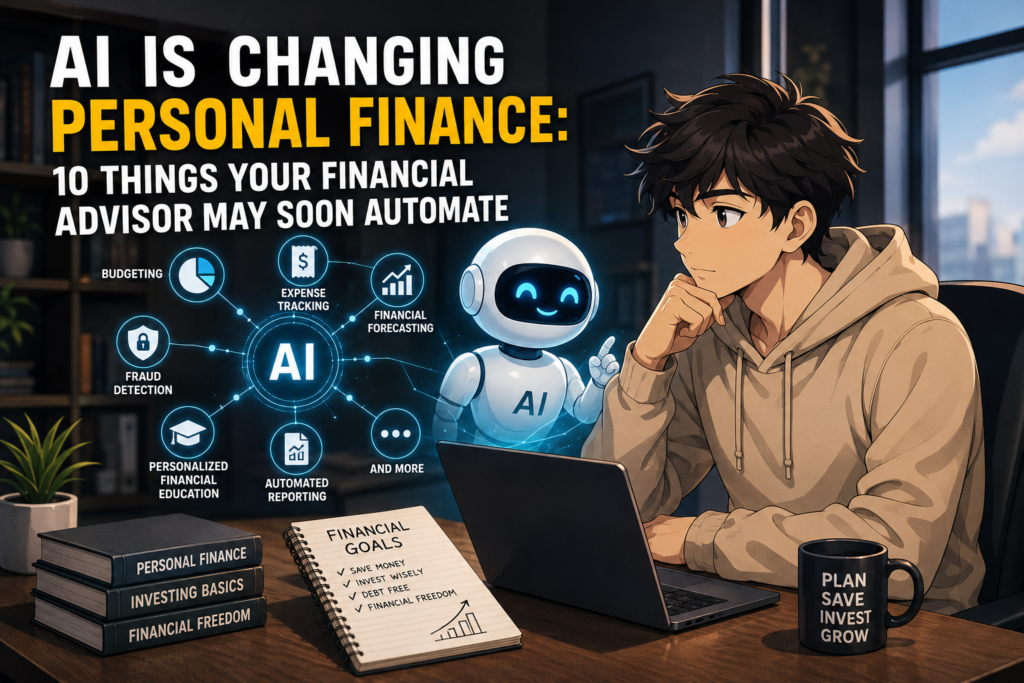
Artificial intelligence is changing the way people manage money.
For years, personal finance depended heavily on spreadsheets, banking apps, financial advisors, and manual calculations. People had to track expenses, create budgets, compare financial products, and make long-term plans on their own or with the help of a professional.
AI is beginning to change that process.
Modern AI systems can analyze large amounts of financial information, identify patterns, make predictions, detect unusual transactions, and provide personalized explanations. As these technologies become more common, some of the routine tasks traditionally handled by financial advisors may become automated.
This does not necessarily mean that financial advisors will disappear. Instead, their role may change. Advisors could spend less time on repetitive calculations and more time helping clients with complex decisions, emotions, goals, and situations that require human judgment.
Here are 10 areas where AI could significantly change personal finance.
1. AI Could Automate Budgeting
Creating a budget sounds simple, but many people struggle to maintain one.
A traditional budget requires you to calculate your income, list your expenses, divide spending into categories, and decide how much money should go toward savings, investments, debt payments, and everyday spending.
AI can make this process much easier.
Instead of manually entering every expense, an AI-powered financial system could analyze your bank and credit card transactions and automatically organize them into categories such as:
- Housing
- FoodT
- ransportation
- Entertainment
- Shopping
- Insurance
- Debt payments
- Savings
- Investments
The system could then compare your actual spending with your financial goals.
For example, imagine you earn $5,000 per month. Your AI financial assistant notices that you are spending $700 on restaurants and food delivery, while your original goal was $400.
Instead of simply showing you a number, the AI could explain:
“You are spending about $300 more than your food budget each month. Reducing this expense could help you save approximately $3,600 per year.”
This makes budgeting more practical.
AI could also create different budgets based on your priorities. If your goal is to buy a home, the system might recommend a more aggressive savings plan. If your priority is paying off credit card debt, it could redirect more money toward debt repayment.
The biggest advantage is automation. Your budget could continuously update as your financial situation changes.
2. AI Could Automate Expense Tracking
Expense tracking is one of the most boring parts of personal finance.
People often forget where their money went.
Small purchases may not seem important individually, but they can become a large expense over an entire year.
AI can automatically monitor transactions and identify spending patterns.
For example, an AI system might notice:
“You purchased coffee 18 times this month.”
Or:
“Your online shopping expenses increased by 35% compared with last month.”
This information can be much more useful than simply seeing a bank statement.
AI could also recognize recurring payments and subscriptions.
You might have subscriptions that you rarely use but continue paying for every month. An AI assistant could identify them and notify you.
For example:
“You are currently paying $29.99 per month for three entertainment subscriptions. You have not used one of them recently.”
The system could then ask whether you want to review or cancel the subscription.
Over time, AI could create a detailed picture of your spending behavior.
It may learn that you spend more on weekends, shop more during certain months, or increase spending when your income rises.
That information could help people understand their financial habits instead of simply looking at numbers.
3. AI Could Improve Financial Forecasting
One of the most valuable things a financial advisor does is help clients think about the future.
How much money will you have in 10 years?Can you afford to buy a home?
When could you potentially retire?
How much should you save every month?
Traditionally, these calculations require financial models and assumptions.
AI can make financial forecasting faster and more personalized.
An AI system could analyze your income, expenses, savings rate, investments, debt, inflation assumptions, and financial goals.It could then create different scenarios.
For example:
ScenarioA: Save $500 per month.
Scenario B: Save $800 per month.
Scenario C: Save $1,000 per month.
The system could show how each decision might affect your future financial position.
It could also respond to changes.If your salary increases, the forecast could automatically update.
If you take a new loan, the AI could calculate how that debt may affect your future cash flow.However, forecasting should never be treated as a guarantee.
Financial markets are unpredictable. Inflation can change, investment returns can vary, and unexpected expenses can happen.
AI can estimate possible outcomes, but it cannot know the future with certainty.
4. AI Could Help Detect Financial Fraud
Fraud detection is another area where AI can be extremely useful.
Banks and financial institutions already use automated systems to identify suspicious transactions. AI can analyze transaction patterns and detect behavior that looks unusual.
For example, imagine your card is normally used in one city.
Suddenly, there are several large transactions from another country.
An AI system could identify the unusual activity and trigger an alert.
AI can look at many factors simultaneously, including:
- Transaction amount
- Location
- Time
- Merchant
- Device
- Previous spending behavior
- Transaction frequency
This can help identify potentially fraudulent activity faster.
AI could also help consumers recognize scams.
For example, an AI financial assistant might analyze a suspicious financial message and warn:
“This message contains several signs commonly associated with financial scams. Do not share your password or banking information.
“This could become increasingly important as scammers also begin using AI to create more convincing messages.
The technology is therefore likely to become part of an ongoing battle between fraud prevention and increasingly sophisticated fraud.
5. AI Could Provide Personalized Financial Education
Financial education has traditionally been generic.
A book might explain investing.
A website might explain credit scores.
A course might explain budgeting.
But everyone has different financial situations.
AI could make financial education highly personalized.
Instead of asking, “What is compound interest?
” a person could ask:”Explain compound interest using my monthly savings.
“The AI could then create an example based on the person’s situation.
Someone who is new to investing might receive a simple explanation.
An experienced investor could receive a more detailed explanation.
AI could also explain complicated financial terms in everyday language.
For example, instead of giving a technical definition of an annual percentage rate, an AI assistant could explain what it means for the actual cost of borrowing money.
This could make financial information easier for beginners to understand.
The goal should not be to make people dependent on AI.
The goal should be to help people become more financially informed.
6. AI Could Automate Financial Goal Planning
People have different financial goals.
Someone may want to buy a house.
Another person may want to pay off student loans.
Someone else may want to build an emergency fund or prepare for retirement.
AI could turn these goals into financial plans.
Suppose your goal is to save $20,000 for a home down payment.
An AI assistant could consider your income, existing savings, monthly expenses, and target date.
It could then estimate how much you may need to save each month.
If the required amount is too high, it could show alternative strategies.
For example:
- Extend the timeline.
- Reduce certain expenses.
- Increase monthly savings.
- Increase income.
- Adjust the target amount.
This could make financial goals feel more achievable because they become specific actions rather than vague wishes.
AI could also track progress automatically.
Instead of checking your financial plan once a year, you could receive regular updates about whether you are moving toward your goal.
7. AI Could Help With Debt Management
Debt is one of the biggest financial challenges for many households.
People may have credit cards, personal loans, student loans, auto loans, and mortgages at the same time.
Managing multiple debts can become complicated.
AI could analyze interest rates, balances, minimum payments, and repayment periods.
It could then show different repayment strategies.
For example, it might compare:
Debt strategy 1: Pay the highest-interest debt first.
Debt strategy 2: Pay smaller balances first for psychological motivation.
Debt strategy 3: Consolidate certain debts if appropriate.
The AI could also show how additional payments might change the repayment timeline.
For example:
“An additional $100 payment each month could reduce the estimated repayment period.”
The exact result would depend on the debt’s interest rate, terms, and other factors.
AI could therefore act as a personal debt organizer.
However, consumers should carefully review recommendations before taking financial action.
8. AI Could Personalize Investment Information
Investment advice is another area where AI could have a major impact.
Instead of providing the same information to everyone, AI could organize financial information according to a person’s goals, time horizon, and risk preferences.
For example, a person saving for a goal several decades away may have different
considerations from someone who needs the money in two years.
AI could explain concepts such as:
- Diversification
- Risk
- Asset allocation
- Compound growth
- Market volatility
- Investment fees
It could also help users understand how changes in their financial situation might affect their investment plan.
But this area requires particular caution.
AI-generated investment recommendations can be wrong. A system may also misunderstand a person’s financial circumstances or risk tolerance.
Investors should not assume that an AI-generated answer is automatically correct simply because it sounds confident.
AI can be a useful educational and analytical tool, but important investment decisions may still require qualified professional advice.
9. AI Could Automate Routine Financial Advisor Tasks
Financial advisors do much more than give investment recommendations.
A significant amount of their work can involve routine activities such as organizing information, preparing reports, calculating projections, reviewing transactions, and answering basic questions.
AI could automate many of these tasks.
For example, instead of manually preparing a basic financial summary, an AI system could generate one automatically.
An advisor could then spend more time discussing important questions with the client.
This could potentially make financial advice more efficient.
It may also reduce the cost of some financial services.
In the future, consumers could potentially have access to a combination of AI-powered financial tools and human advisors.
AI could handle repetitive tasks.
Humans could handle complex decisions.
This combination may be more useful than either technology or humans working alone.
10. AI Could Act Like a 24/7 Financial Assistant
Perhaps the biggest change is accessibility.
Traditional financial advice may require an appointment.
An AI financial assistant could potentially be available at any time.
A person might ask:
“Can I afford this purchase?””
Why did my spending increase this month?””
How much did I save this year?
“”What happens if I increase my monthly savings?
“”Explain this financial term.”
The system could provide an immediate response based on the information available to it.
This could make financial guidance more accessible to people who cannot afford traditional financial planning services.
However, convenience should not be confused with accuracy.
A fast answer is not necessarily a correct answer.
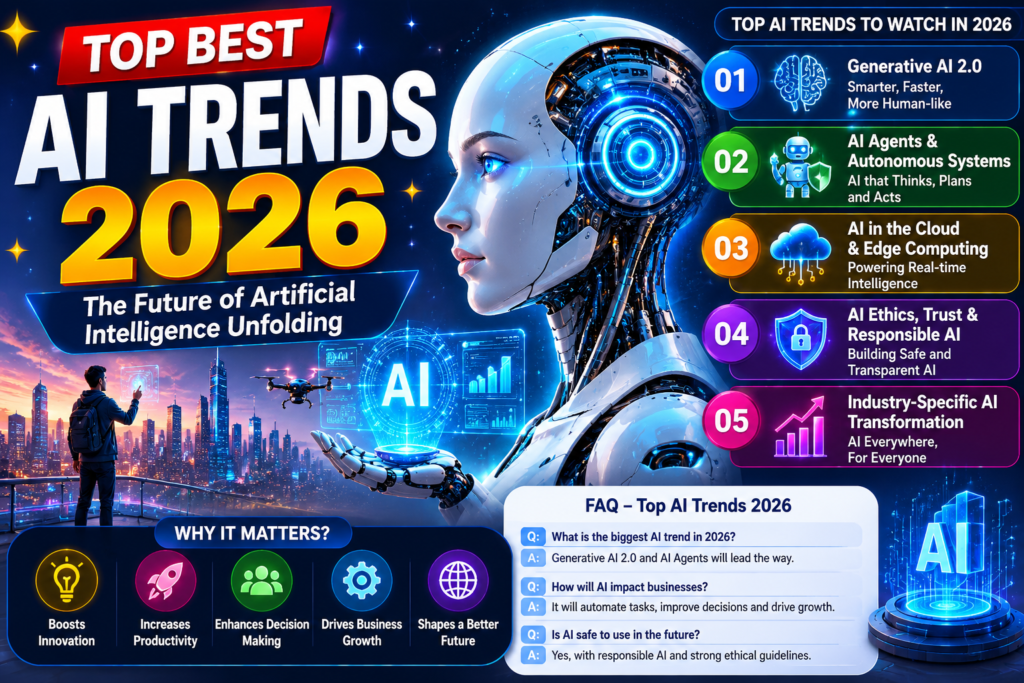
Artificial Intelligence (AI) continues to evolve at a rapid pace, transforming industries, economies, and everyday life. As we step into 2026, AI is no longer just a technological advantage—it has become a foundational layer of modern society. From healthcare and finance to education and entertainment, AI trends in 2026 reveal a future that is more automated, intelligent, and interconnected than ever before.
In this article, we will explore the most important AI trends shaping 2026, their impact, and what they mean for businesses, individuals, and the global economy.
1. Rise of Autonomous AI Agents
One of the biggest breakthroughs in 2026 is the emergence of autonomous AI agents. These are advanced systems capable of performing tasks independently without constant human supervision. Unlike traditional AI tools, these agents can:
- plan tasks
- make dicisions
- learn for outcome
- Adapt in real time
For example, AI agents are now managing entire workflows in businesses—handling customer support, managing supply chains, and even executing marketing campaigns.Impact:
Impact:
This reduces human workload and increases efficiency, but also raises concerns about job displacement and accountability.
2. Generative AI Becomes Mainstream
Generative AI, which gained popularity in earlier years, has now matured significantly in 2026. It is widely used for:
- Content creation (articles, blogs, scripts)
- Image and video generation
- Music production
- Software coding
Companies now rely heavily on generative AI for scaling content and reducing production costs. Tools can generate high-quality, human-like output in seconds.
3. AI in Healthcare Revolution
Healthcare is one of the biggest beneficiaries of AI advancements in 2026. AI is now being used for:
- Early disease detection
- Personalized treatment plans
- Drug discovery
- Remote patient monitoring
AI-powered diagnostic tools can detect diseases like cancer or heart conditions at an early stage with high accuracy.
Example:
AI models analyze medical images faster than doctors, helping reduce diagnosis time and improving patient outcomes.
4. Hyper-Personalization Across Industries
In 2026, personalization has reached a new level—hyper-personalization. AI analyzes user behavior, preferences, and real-time data to deliver highly customized experiences.
Industries using this trend include:
- E-commerce (personalized product recommendations)
- Streaming platforms (custom content suggestions)
- Banking (tailored financial advice)
Impact:
Customers receive more relevant experiences, increasing engagement and satisfaction.
5. AI-Powered Cybersecurity
As cyber threats become more sophisticated, AI is playing a critical role in cybersecurity. AI systems can:
- Detect threats in real-time
- Predict potential attacks
- Automatically respond to breaches
Unlike traditional security systems, AI learns from patterns and continuously improves its defense mechanisms.
Challenge:
Hackers are also using AI, leading to an ongoing battle between defensive and offensive AI technologies.
6. Ethical AI and Regulations
With AI becoming more powerful, ethical concerns are growing. Governments and organizations are focusing on:
- AI transparency
- Data privacy
- Bias reduction
- Responsible AI usage
In 2026, many countries have introduced strict regulations to ensure AI systems are fair and accountable.
Key Focus Areas:
- Explainable AI (understanding how AI makes decisions)
- Ethical data usage
- Preventing misuse of AI technologies
7. AI in Education Transformation
Education systems are being reshaped by AI in 2026. AI-driven platforms provide:
- Personalized learning paths
- Smart tutoring systems
- Automated grading
- Real-time feedback
Students can now learn at their own pace, while teachers use AI insights to improve teaching methods.
Result:
Better learning outcomes and more accessible education worldwide.
8. Integration of AI with IoT (Internet of Things)
AI and IoT are merging to create smarter environments. This integration is visible in:
- Smart home
- smart cities
- industrial automation
Devices now communicate with each other and make decisions without human intervention.
Example:
A smart home system can adjust lighting, temperature, and security automatically based on user behavior.
9. AI in Business Automation
Businesses are increasingly adopting AI to automate operations. This includes:
- customar service chatbot
- data analysis
- HR recruitment processes
- financial forecasting
AI reduces operational costs and increases productivity.
10. Human-AI Collaboration
Instead of replacing humans, AI is increasingly working alongside them. This collaboration is enhancing human capabilities in fields like:
- medicine
- engineering
- creative industries
Professionals use AI as a tool to improve decision-making and efficiency.
Challenges of AI in 2026
Despite its advantages, AI also presents several challenges:
1. Job Displacement
Automation is replacing repetitive jobs, leading to workforce shifts. Upskilling is becoming essential.
2. Data Privacy Concerns
AI relies heavily on data, raising concerns about how personal information is collected and used.
3. Bias in AI Systems
AI models can inherit biases from training data, leading to unfair outcomes.
4. High Implementation Costs
Advanced AI systems require significant investment, making them less accessible for small businesses.
Future Outlook: What Lies Ahead?
Looking beyond 2026, AI is expected to become even more integrated into daily life. Future developments may include:
- Artificial General Intelligence (AGI)
- Fully autonomous transportation systems
- Advanced human-machine interfaces
- AI-driven global problem solving (climate change, disease control)
AI will continue to redefine how humans live and work, making adaptability a crucial skill
Conclusion
AI trends in 2026 highlight a transformative era where technology is deeply embedded in every aspect of life. From autonomous agents to personalized experiences, AI is reshaping industries and creating new opportunities.
However, with great power comes great responsibility. Ethical considerations, regulations, and human oversight will play a critical role in ensuring AI benefits society as a whole.
As we move forward, embracing AI while addressing its challenges will determine how successfully we navigate this technological revolution.
AI Trends 2026 Comparison Table
| AI Trend | How It Works | Future Impact |
|---|---|---|
| Generative AI | Creates text, images, and videos | Faster content creation |
| AI Automation | Automates repetitive tasks | Higher productivity |
| AI Chatbots | Provides smart customer support | Better user experience |
| AI in Healthcare | Assists doctors and hospitals | Faster diagnosis |
| AI Cybersecurity | Detects online threats | Improved digital safety |
| AI Robotics | Uses smart machines for work | Advanced automation |
| Personalized AI | Understands user behavior | Customized experiences |
| AI in Education | Smart learning systems | Better online education |
| Voice AI Assistants | Human-like voice interaction | Easier daily tasks |
| AI Data Analytics | Real-time data analysis | Smarter business decisions |
FAQ Question
1. What are the top AI trends in 2026?
The top AI trends in 2026 include generative AI, AI-powered automation, smart assistants, AI healthcare systems, robotics, cybersecurity AI, and personalized customer experiences.
2. How will AI change businesses in 2026?
AI will help businesses improve productivity, automate tasks, reduce costs, and provide better customer support through intelligent systems and data analysis.
3. Is Artificial Intelligence growing in 2026?
Yes, Artificial Intelligence is growing rapidly in 2026 and becoming an important part of healthcare, education, finance, marketing, and daily life.
4. How is AI helping healthcare in 2026?
AI helps healthcare through faster diagnosis, virtual health assistants, remote monitoring, personalized treatments, and advanced medical research.
5. What is the future of AI technology?
The future of AI technology includes smarter automation, human-like AI assistants, self-learning systems, advanced robotics, and safer digital environments.
6. Will AI replace human jobs in 2026?
AI may automate some repetitive jobs, but it will also create new opportunities in technology, data science, AI management, and digital services.
7. Why are AI trends important for businesses?
AI trends help businesses stay competitive, improve efficiency, understand customer behavior, and increase overall growth.