The Ultimate Guide to Scaling a SaaS Business in 2026 | Growth Strategies & Success Tips
Learn how to scale a SaaS business in 2026 with proven growth strategies, customer retention tips, AI automation, pricing models, and marketing techniques. A complete beginner-to-advanced SaaS growth guide.
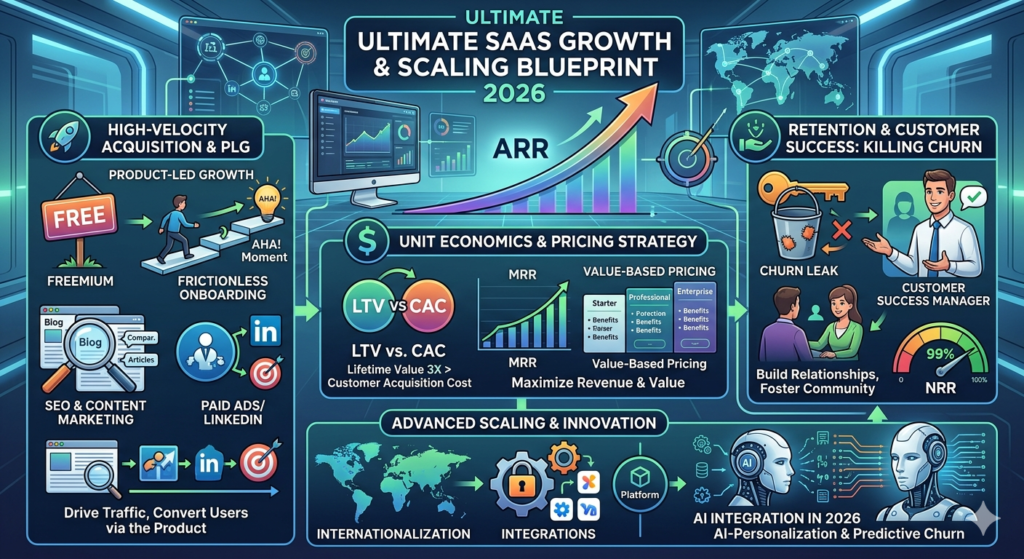
The Software as a Service (SaaS) industry has undergone a massive transformation. We are no longer in the era where simply “building a good tool” is enough. Today, the market is crowded, customer acquisition costs (CAC) are rising, and the barrier to entry is lower than ever due to AI-assisted coding. To grow a SaaS business in this environment, you need a sophisticated, multi-layered strategy that balances aggressive acquisition with obsessive retention.
1. The Core Philosophy of SaaS Growth
Before diving into tactics, it is crucial to understand that SaaS growth is not linear; it is compounded. Unlike a traditional product sale where the transaction ends at the point of purchase, a SaaS sale is the beginning of a relationship.
The Growth Triad
Success in SaaS is built on three pillars:
- Acquisition : Driving the right traffic and converting it into users.
- Monetization: Optimizing your pricing tiers to extract maximum value.
- Retention: Keeping users active and preventing “churn” (the silent killer of SaaS).
If any of these pillars are weak, the business will eventually plateau or collapse under its own weight.
2. Product-Led Growth (PLG): The Modern Standard
In 2026, the most successful SaaS companies use their product as the primary driver of customer acquisition and expansion. This is known as Product-Led Growth (PLG).
The Freemium vs. Free Trial Debate
- Freemium: Best for products with a “viral loop” (like Slack or Notion). It allows a massive user base to test the product, but you must ensure the free tier provides enough value to be useful while keeping the “must-have” features behind a paywall.
- Free Trial: Best for complex B2B tools where the user needs to experience the full power of the software to justify a high price point. Usually, a 14-day trial with “all-access” is the industry standard.
Frictionless Onboarding
Your growth strategy will fail if your onboarding is clunky. You must aim for the “Aha! Moment”—the exact point where a user realizes the value of your software.
- Time-to-Value (TTV): Reduce the time it takes for a user to complete their first successful task.
- Interactive Tours: Use tools like WalkMe or Pendo to guide users visually rather than forcing them to read a manual.
3. High-Velocity Acquisition Channels
To scale to a 1300+ word level of impact, your marketing must be diversified. Relying on a single channel is a recipe for disaster.
Search Engine Optimization (SEO) & Topical Authority
SEO in SaaS has evolved. It’s no longer about keyword stuffing; it’s about Topical Authority.
- Programmatic SEO: Create thousands of landing pages for specific use cases (e.g., “Best CRM for Dentists,” “Best CRM for Lawyers”).
- The Help Hub: Build a massive library of educational content that answers every possible question your target audience might ask, even if it doesn’t directly mention your product.
Performance Marketing & LinkedIn Mastery
For B2B SaaS, LinkedIn is the goldmine.
- Account-Based Marketing (ABM): Instead of showing ads to everyone, target specific companies that fit your Ideal Customer Profile (ICP).
- Retargeting: Use Google and Meta ads to follow users who visited your pricing page but didn’t sign up.
4. The Economics of SaaS: Metrics That Matter
You cannot manage what you do not measure. To grow, you must obsess over your “Unit Economics.”
The SaaS North Star: LTV vs. CAC
LTV (Lifetime Value) is the total revenue a customer generates before they cancel. CAC (Customer Acquisition Cost) is what you spend to get them.
The Golden Rule: Your LTV should be at least 3x your CAC. If it is lower, you are spending too much to acquire customers. If it is significantly higher, you are likely under-investing in growth.
Churn: The Growth Leaking Bucket
There are two types of churn:
- Logo Churn: The percentage of customers who leave.
- Revenue Churn: The amount of money you lose.In a healthy SaaS, you should aim for Negative Revenue Churn. This happens when the extra money you make from existing customers (through upgrades) is more than the money you lose from people leaving.
5. Pricing Strategy: The Lever of Growth
Most SaaS founders set their price once and never touch it again. This is a mistake. Pricing is your most powerful lever for increasing revenue without acquiring a single new customer.
saas scaling strategies
| SaaS Growth Area | Strategy | Business Benefit |
|---|---|---|
| Customer Acquisition | SEO and content marketing | More organic traffic |
| AI Automation | Use AI tools and chatbots | Better productivity |
| Pricing Strategy | Tiered subscription plans | Higher revenue |
| Customer Retention | Improve support and onboarding | Lower churn rate |
| Product Development | Add user-focused features | Better engagement |
| Data Analytics | Track customer behavior | Smarter decisions |
| Cloud Infrastructure | Scalable cloud hosting | Better performance |
| Email Marketing | Automated campaigns | More conversions |
| Global Expansion | Multi-language support | Wider audience reach |
| Cybersecurity | Strong data protection | Increased trust |
| Team Collaboration | Remote work tools | Faster workflow |
| Mobile Optimization | Mobile-friendly SaaS apps | Better user experience |
| Referral Programs | Reward customer referrals | More signups |
| Personalization | AI-based recommendations | Higher customer satisfaction |
| Performance Tracking | KPI and MRR monitoring | Sustainable growth |
Value-Based Pricing
Stop pricing based on your costs or your competitors. Price based on the value you provide. If your software saves a company $10,000 a month in labor, charging $500 a month is a steal.
Tiered Packaging
- Starter: Low barrier to entry.
- Professional: The “Sweet Spot” where most of your revenue comes from.
- Enterprise: Custom pricing with high-security features and dedicated support.
6. Retention and Customer Success
In SaaS, the sale doesn’t end at the “Buy” button. To grow, you must keep the customer forever.
The Role of Customer Success (CS)
Unlike Customer Support (which is reactive), Customer Success is proactive. CS managers reach out to users who haven’t logged in for a week to help them get back on track.
Community Building
Create a Slack group, a Discord server, or a forum for your users. When users talk to each other, they become “sticky.” They aren’t just buying software; they are joining a community of peers.
7. Scaling through Ecosystems and Integrations
A standalone SaaS is vulnerable. An integrated SaaS is indispensable.
- The Marketplace Strategy: If you build a CRM, make sure it connects to Gmail, Slack, Zapier, and Shopify.
- API-First Approach: Allow other developers to build tools on top of your software. This turns your product into a Platform, which is much harder for a customer to leave.
8. The AI Revolution in SaaS Growth
In 2026, AI is no longer a “feature”—it is the foundation.
- AI-Powered Personalization: Use AI to change your website’s headline based on who is visiting. If a CEO visits, show “Increase ROI.” If a Developer visits, show “Clean API Documentation.”
- Predictive Churn: Use machine learning to identify users who are likely to cancel before they actually do, and offer them a discount or a training session automatically.
9. Expanding into International Markets
Once you have conquered your home market, growth comes from “Localization.”
- Multi-Currency Support: Let people pay in their local currency.
- Cultural Adaptation: It’s not just about translating the language; it’s about changing the marketing message to fit the local culture’s business style.
10. Conclusion: The Long Game
Growing a SaaS business to millions in ARR (Annual Recurring Revenue) is a marathon. It requires a relentless focus on the user experience and a data-driven approach to marketing.
Summary Checklist for 2026 Growth:
- Optimize for PLG: Let the product sell itself.
- Master the Metrics: Keep your LTV:CAC ratio healthy.
- Kill Churn: Focus on customer success as much as sales.
- Integrate: Become a part of the user’s daily tech stack.
- Innovate with AI: Use automation to personalize the journey.
By following this framework, you don’t just build a software company; you build a revenue engine that grows while you sleep.
summary :
This article provides a comprehensive blueprint for scaling a SaaS business in 2026, emphasizing that growth is a result of a compounded relationship with the customer rather than a one-time transaction. The guide breaks down the growth process into several critical pillars, starting with Product-Led Growth (PLG), where the product itself serves as the primary driver for acquisition through frictionless onboarding and “Aha! moments.”
The strategy highlights the importance of balancing Acquisition (via SEO and LinkedIn), Monetization (through value-based pricing), and Retention (by fighting churn). Key metrics like the LTV to CAC ratio are identified as the “North Star” for financial health, suggesting that a customer’s lifetime value should be at least three times the cost of acquiring them.
Furthermore, the article explores advanced scaling tactics such as:
- Negative Revenue Churn: Increasing revenue from existing customers via upsells.
- Ecosystem Integration: Making the software indispensable by connecting it with other major tools.
- AI Integration: Utilizing artificial intelligence for predictive churn analysis and personalized user experiences.
The summary concludes that sustainable SaaS success in the modern era requires a shift from a “sales-first” mindset to a “value-first” approach, focusing on long-term customer success and building a product that integrates seamlessly into a user’s daily workflow.
FAQ Question
1. What is a SaaS business?
A SaaS business provides software through the internet on a subscription basis instead of one-time downloads.
2. How can I scale a SaaS business fast?
You can scale faster by improving customer experience, using AI automation, investing in SEO, and focusing on recurring revenue.
3. Why is customer retention important in SaaS?
Customer retention increases monthly recurring revenue (MRR) and reduces customer acquisition costs.
4. What are the best marketing strategies for SaaS in 2026?
Content marketing, SEO, email marketing, influencer partnerships, and AI-powered advertising are highly effective.
5. How does AI help SaaS companies grow?
AI helps automate customer support, improve analytics, personalize marketing, and increase productivity.
6. What is MRR in SaaS?
MRR stands for Monthly Recurring Revenue, which measures predictable monthly income from subscriptions.
7. Which pricing model is best for SaaS businesses?
Freemium, subscription-based, and tiered pricing models are commonly used for SaaS growth.
8. How important is SEO for SaaS companies?
SEO helps SaaS businesses get long-term organic traffic, leads, and brand visibility without depending only on paid ads.