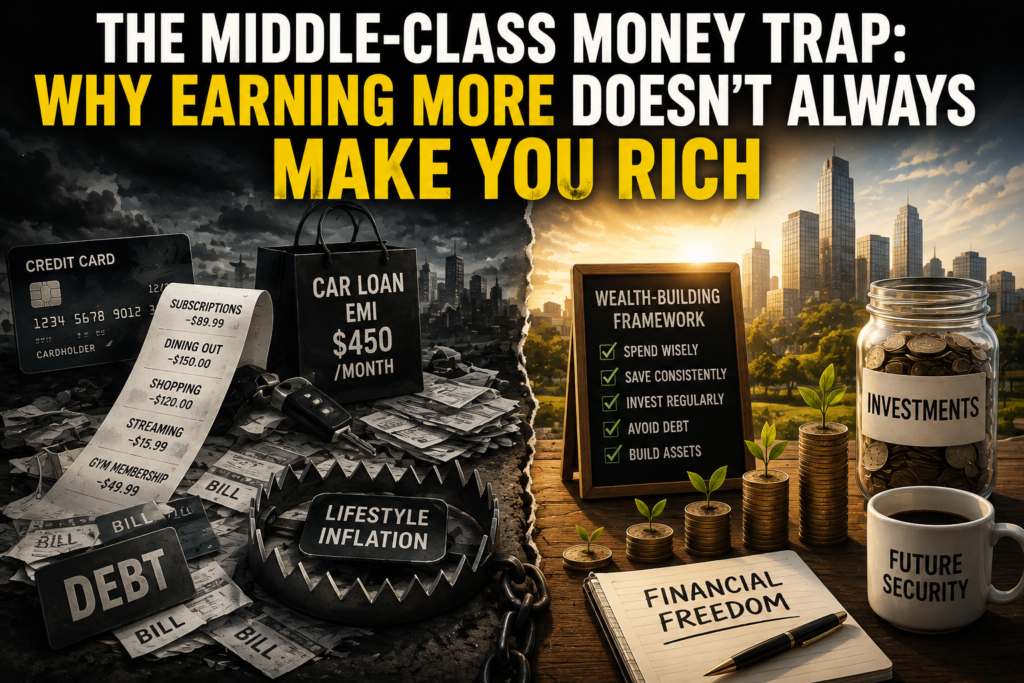
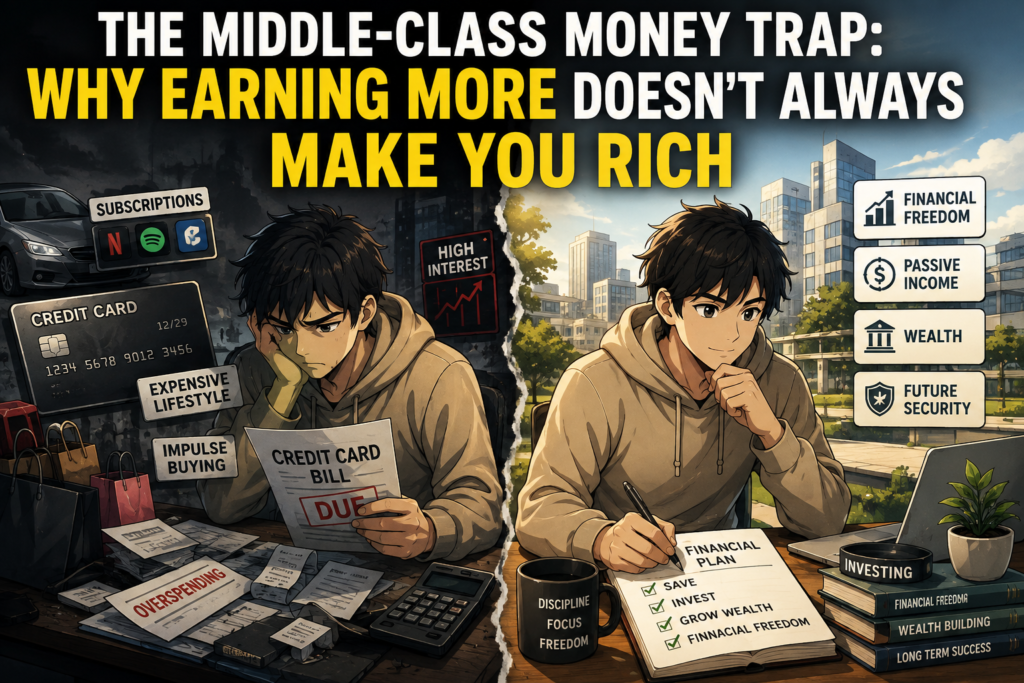
“What if I told you that earning $100,000 a year could still leave you broke?
You get a raise, buy a better car, move into a nicer home, subscribe to more services, eat out more often—and suddenly, your higher salary disappears just as quickly as your old one did.
The real problem isn’t that you don’t earn enough.
The problem is that every time your income goes up, your lifestyle goes up with it.
And that’s the middle-class money trap.In this article, you’ll learn why earning more doesn’t always make you rich—and the simple framework you can use to turn a higher income into real wealth.”
Introduction
Many people believe that becoming wealthy is simple:
Earn more money, spend less money, save the difference, and eventually you will become rich.But real life is not always that simple.A person earning $50,000 a year may struggle financially. Then they get a better job and start earning $100,000.
At first, life feels much easier. They can afford a better car, a bigger home, more subscriptions, expensive restaurants, better vacations, and new gadgets.But after a few years, something strange happens.
Even though their income has doubled, they still do not feel financially free.
Their bank account may still be low. Their credit card balance may still be high. Their monthly payments may have increased. They may still be waiting for the next paycheck.This is one of the biggest financial problems facing the modern middle class. It is often called lifestyle inflation.
Lifestyle inflation happens when your spending increases as your income increases. Instead of using additional income to build wealth, you use it to build a more expensive lifestyle.The result is simple: You earn more, but you do not become much wealthier.
This article explains the middle-class money trap, how lifestyle inflation works, how car loans, subscriptions, and credit cards can quietly damage your finances, and how you can create a simple wealth-building framework.
What Is the Middle-Class Money Trap?
The middle-class money trap is not simply about having a low income.
It is a cycle where your income increases, but your expenses increase almost at the same speed.For example, imagine someone earns $50,000 per year.
They may live in a small apartment, drive an older car, cook at home, and carefully control their spending. Then they get a new job paying $75,000. Their financial situation improves.
But they start thinking:”I can afford better things now.”They buy a newer car. Then they move into a more expensive apartment. They add streaming services. They eat out more often. They take more expensive vacations.They start using credit cards for purchases.
Eventually, their $75,000 income does not feel much different from their old $50,000 income. Then they receive another promotion and start earning $100,000. The cycle continues. This is the trap. The problem is not earning more money. The problem is allowing every increase in income to become an increase in lifestyle.
Lifestyle Inflation: The Silent Wealth Killer
Lifestyle inflation is one of the biggest reasons people with good salaries still struggle to build wealth. Imagine your income increases by $20,000 per year. You might think:
“$20,000 more means I can save $20,000 more.”
Unfortunately, that is rarely what happens.Instead, you might spend:
- $5,000 on a better car
- $2,000 on restaurants
- $1,500 on subscriptions
- $3,000 on vacations
- $2,000 on shopping
- $2,500 on a better apartment
Suddenly, most of your additional income has disappeared. You are earning more, but your wealth has barely changed.
Why Lifestyle Inflation Is Dangerous
Lifestyle inflation is dangerous because it does not always feel like overspending. You may not buy one extremely expensive item.Instead, your lifestyle becomes slightly more expensive in many different areas.
A $10 monthly subscription does not feel dangerous. A $200 monthly car payment may not feel dangerous. An extra $100 spent on restaurants each month may not feel dangerous. But together, these expenses can consume thousands of dollars every year.
The biggest problem is that once you become comfortable with a lifestyle, reducing it can feel difficult. That is why controlling lifestyle inflation is easier than trying to reverse it later.
The $50K vs. $100K Income Problem
Let’s compare two hypothetical people.
Person A: $50,000 Income
Suppose Person A earns $50,000 per year. They live simply and spend around $35,000 per year. They save and invest the remaining $15,000.
Person B: $100,000 Income
Person B earns twice as much. You might assume Person B is automatically much wealthier. But suppose Person B spends $90,000 per year. They save only $10,000. Now compare them.
| Person A | Person B | |
|---|---|---|
| Annual Income | $50,000 | $100,000 |
| Annual Spending | $35,000 | $90,000 |
| Potential Savings | $15,000 | $10,000 |
| Lifestyle | Simple | Expensive |
Person B earns twice as much money but saves less. This shows an important financial principle: Income creates opportunity. Spending determines how much of that opportunity becomes wealth. A higher income is powerful, but only if you keep enough of it.
More Income Does Not Automatically Mean More Wealth
There is an important difference between income and wealth. Income is the money you receive. Wealth is the value of what you own minus what you owe. For example, someone earning $150,000 but carrying $100,000 of debt may have less financial security than someone earning $80,000 with substantial investments and little debt.
High income can help you build wealth faster. But income alone does not guarantee wealth. You need to convert income into assets.
These assets might include:
- Retirement accounts
- Broad investment funds
- Stocks
- BondsReal estate
- A profitable business
- Cash savings
- Other productive assets
The goal is not simply to earn more.
The goal is to make your money work for you.
The Car Loan Trap
Cars are one of the easiest ways to increase lifestyle costs. When people receive a raise, one of the first things they may consider is buying a better car. Instead of driving a reliable $15,000 car, they may decide they can now afford a $40,000 or $50,000 vehicle.
The problem is that the cost of a car is not only the monthly loan payment.
You also have:
- Insurance
- Fuel
- Maintenance
- Repairs
- Registration
- Depreciation
- Interest on the loan
A car payment of $700 may not sound terrible when you earn $100,000. But $700 per month is $8,400 per year, before considering many other vehicle costs. A more expensive car can also influence other spending. You may start paying for premium parking, better accessories, expensive insurance, or more frequent upgrades. A vehicle should serve your financial life.
It should not control it.
Modern consumers can subscribe to almost everything.
You might have:
- Video streaming
- Music streaming
- Cloud storage
- Fitness apps
- Gaming services
- Food delivery memberships
- Premium news services
- Productivity software
- Online shopping memberships
One subscription might cost only $10 or $15 per month. The problem appears when you have 10 or 15 subscriptions.
For example:
$15 + $12 + $10 + $20 + $10 + $15 + $12 = $94 per month.
That is more than $1,100 per year. The money may leave your account automatically, so you barely notice it. This is why subscriptions should be reviewed regularly. Ask yourself: “Did I use this service during the last 30 days?” If the answer is no, consider cancelling it.
Credit Cards: Convenience Can Become Debt
Credit cards are not automatically bad. Used responsibly, they can be useful for payments, rewards, fraud protection, and building credit history. The problem begins when credit cards are used to finance a lifestyle that income cannot support.
For example, someone may buy:
- A new phone
- Designer clothing
- Restaurant meals
- Vacation tickets
- Electronics
They may think:
“I will pay it later.”
But “later” eventually arrives.
If the balance is not paid in full, interest can make purchases much more expensive. Credit card debt can also create a dangerous cycle. You use your paycheck to pay old expenses.
Then you use the credit card again because your paycheck is no longer enough. This creates a financial treadmill. You keep working, but you do not move forward.
The Difference Between Looking Rich and Being Rich
One of the biggest lessons in personal finance is that wealth is often invisible. Someone driving an expensive luxury car may look wealthy. But they might have a large loan.Someone wearing expensive clothes may look successful. But their credit card balance may be growing. Meanwhile, someone driving an older car and living in a simple home may have hundreds of thousands of dollars invested.
You cannot always see wealth. True wealth is financial flexibility. It means you have assets. You have savings. You have manageable debt. You can handle unexpected expenses. And you do not need your next paycheck to survive.
The Wealth-Building Framework
So how can you escape the middle-class money trap?
You do not need a complicated strategy.
Start with a simple framework.
Step 1: Increase Your Income
Income still matters. Look for ways to improve your earning power.
This could include:
- Learning valuable skills
- Changing jobs
- Negotiating salary
- Starting a side business
- Freelancing
- Building professional certifications
- Developing expertise in a high-demand field
The goal is to increase the amount of money entering your financial system.
But remember:
Do not automatically increase your lifestyle every time your income increases.
Step 2: Control Your Lifestyle
You do not need to live an extremely cheap life.
The goal is not to avoid spending money.
The goal is to spend intentionally.
You can enjoy restaurants, travel, entertainment, and comfortable living.
But these expenses should fit within your financial plan.
A useful rule is:
When your income increases, increase your investments before increasing your lifestyle.
For example, if your salary increases by $10,000, you could decide that a large portion of that increase goes toward investing.
You still enjoy some of the raise, but you also increase your wealth.
Step 3: Build an Emergency Fund
Before focusing heavily on long-term investing, create a financial safety net.
An emergency fund can help you handle unexpected expenses such as:
- Job loss
- Car repairs
- Home repairs
- Medical expenses
- Family emergencies
- Other unexpected bills
The exact amount depends on your situation.
Many people aim for several months of essential living expenses.
The important point is that emergency savings can prevent you from turning an unexpected expense into expensive debt.
Step 4: Eliminate High-Interest Debt
High-interest debt can destroy your wealth-building progress. If your investments are growing slowly while your credit card debt is charging a much higher interest rate, your financial system is working against you.
Focus on expensive consumer debt. Paying down high-interest debt can provide a guaranteed financial benefit because you are reducing future interest costs. Once expensive debt is under control, you can focus more heavily on long-term investing.
Step 5: Invest Consistently
Saving money is important. But long-term wealth usually requires investing as well. Money sitting in a basic savings account may be useful for emergencies and short-term goals, but long-term money can potentially benefit from productive assets.
Depending on your goals, risk tolerance, and country, this could include diversified investments such as broad-market funds, retirement accounts, bonds, or other suitable assets. The key is consistency. You do not need to become a professional investor. You need a system that you can follow for years.
Step 6: Avoid Lifestyle Upgrades That Create Long-Term Payments
Before taking on a new monthly payment, ask yourself: “Would I still want this if I had to pay the entire cost today?”
This question can change your financial decisions.
A $500 monthly payment may sound manageable. But five years of payments can represent a significant amount of money. Monthly payments can make expensive purchases feel cheaper than they really are. Always look at the total cost.
Step 7: Track Your Net Worth
Your salary is not the only number that matters.
Track your net worth.
The basic formula is:
Net Worth = Assets − Liabilities
Assets include things you own that have financial value.
Liabilities include money you owe.
For example:
Assets = $200,000Debt = $80,000
Net worth = $120,000
Your goal should be to increase your net worth over time.
A higher salary is useful.
But a growing net worth is a better measure of financial progress.
A Simple Rule for Every Raise
Here is a simple strategy that can help prevent lifestyle inflation
Whenever your income increases:
Save and invest first. Upgrade your lifestyle second.
For example, imagine you receive a $10,000 annual raise.
Instead of spending the entire amount, you might decide:
$6,000 toward investing
$2,000 toward financial goals
$2,000 for lifestyle improvements
The exact percentages do not matter as much as the habit.
This creates a balance.
You enjoy your higher income while also becoming wealthier.
Wealth Is a Long Game
Building wealth is not about looking successful next month. It is about creating financial strength over many years. The person who earns $100,000 and spends $99,000 may look successful. But the person who earns $100,000, lives on $65,000, and invests the difference may be quietly building a much stronger financial future.
This does not mean you should never enjoy your money. Money exists to improve your life. The goal is to create a lifestyle that you can afford and a financial future that you can depend on.
Final Thoughts
The middle-class money trap is not caused by one expensive purchase.
It usually happens slowly.
A bigger salary leads to a better car.
A better car leads to higher insurance and payments.
A better apartment increases rent.
More income creates more restaurant spending.
Credit cards make expensive purchases easier.
Subscriptions quietly increase monthly expenses.
Eventually, your lifestyle becomes expensive enough that even a good salary feels insufficient.
The solution is not necessarily to earn less or stop enjoying life.
The solution is to build a system where your income creates wealth before it creates lifestyle inflation.
Remember these principles:Earn more.Keep lifestyle inflation under control.
Avoid unnecessary high-interest debt.
Save for emergencies.
Invest consistently.
Track your net worth.
Use raises to build assets.
Most importantly, understand this:
A high income can make you look rich, but only good financial habits can help you become wealthy.
The real goal is not to have the most expensive lifestyle.
The real goal is to reach a point where your money gives you choices
That is what financial freedom looks like.
Frequently Asked Questions (FAQ)
1. What is the middle-class money trap?
The middle-class money trap happens when your income increases but your spending increases at the same time. You may earn more money but still have little savings or wealth.
2. Why doesn’t earning more money always make you rich?
Because higher income does not automatically create wealth. If most of the additional income goes toward expensive cars, bigger homes, subscriptions, dining, and credit card payments, your savings may remain low.
3. What is lifestyle inflation?
Lifestyle inflation means increasing your spending as your income increases. For example, getting a raise and immediately upgrading your car, home, vacations, or shopping habits.
4. Is a $100,000 salary enough to become wealthy?
A $100,000 salary can provide a strong opportunity to build wealth, but it depends on spending, debt, saving, investing, taxes, and location. Someone earning $100,000 and spending $90,000 may build less wealth than someone earning $50,000 and saving $15,000.
5. Are car loans bad for building wealth?
Not necessarily, but an expensive car loan can reduce the amount of money available for saving and investing. Always consider the total cost of the vehicle, including interest, insurance, fuel, maintenance, and depreciation.
6. Can credit cards prevent you from becoming wealthy?
Credit cards themselves are not necessarily a problem. The bigger problem is carrying high-interest balances and using credit to maintain a lifestyle you cannot comfortably afford.
7. How can I avoid lifestyle inflation?
When your income increases, avoid immediately increasing your expenses. Consider directing a large portion of every raise toward savings, investments, debt repayment, or other financial goals.
8. How much money should I save from my income?
There is no single percentage that works for everyone. A practical goal is to gradually increase your savings rate as your income grows. The important thing is to create a consistent habit and increase it over time.
9. What is the difference between income and wealth?
Income is the money you earn, usually from a job or business. Wealth is the value of your assets minus your debts. A high income can help you build wealth, but it does not guarantee it.
10. How can I start building wealth?
Start with a simple system: control unnecessary spending, build an emergency fund, pay down high-interest debt, invest consistently, and increase your savings when your income grows.
11. Should I invest all of my extra income?
Not necessarily. You should also consider emergency savings, debt repayment, short-term goals, and your personal financial situation. Investing should be part of a balanced financial plan.
12. What is the most important lesson about building wealth?
Earning more is only half the equation. Keeping, saving, and investing a meaningful portion of your income is what can turn a higher salary into long-term wealth.