What if you lost your job tomorrow?
Would your emergency fund be ready—or would your money be locked away when you need it most?
In 2026, you have two popular options:
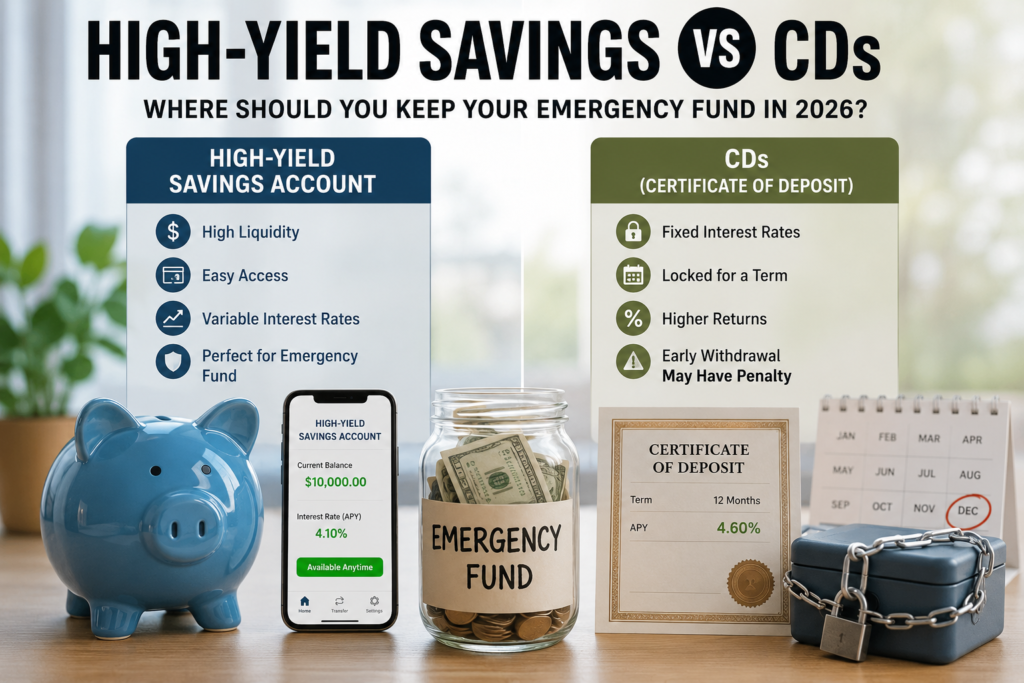
High-Yield Savings Accounts and CDs. Both can earn interest, but they work very differently.
One gives you easy access to your money. The other can offer higher and more predictable returns.
So, where should you actually keep your emergency fund?
Let’s break it down with simple examples and real calculations.
High-Yield Savings Accounts vs CDs: Where Should You Keep Your Emergency Fund in 2026?
An emergency fund is one of the most important parts of a healthy financial life. It gives you money to use when something unexpected happens, such as losing your job, paying a large medical bill, repairing your car, or handling an urgent family expense.
But there is an important question many people do not think about:
Where should you keep your emergency fund?
Keeping all your emergency money in a regular checking account may make it easy to access, but the money may earn very little interest. On the other hand, putting your money into a Certificate of Deposit, commonly called a CD, can give you a higher or more predictable return, but your money may be locked for a fixed period.
A High-Yield Savings Account (HYSA) sits somewhere in between. It can offer a much better interest rate than many traditional savings accounts while allowing you to access your money when you need it.
So, which one is better for an emergency fund in 2026?The answer depends on how much liquidity you need, how much interest you want to earn, and how you structure your emergency savings.
This guide explains the difference between high-yield savings accounts and CDs in simple English, including APY, real calculation examples, liquidity, returns, and when each option makes sense.
What Is an Emergency Fund?
An emergency fund is money set aside specifically for unexpected expenses.
It is not normally meant for vacations, shopping, a new phone, or entertainment.
Instead, it can help you handle situations such as:
- Job loss
- Emergency home repairs
- Car repairs
- Unexpected medical expenses
- Family emergencies
- Sudden travel requirements
- Temporary loss of income
- Large unexpected bills
A common goal is to build an emergency fund equal to three to six months of essential living expenses.
For example, suppose your essential monthly expenses are $3,000.
A three-month emergency fund would be:
$3,000 × 3 = $9,000
A six-month emergency fund would be:
$3,000 × 6 = $18,000
The important thing is not simply having the money. You also need to keep it somewhere that balances safety, access, and reasonable returns.
That is where HYSAs and CDs come into the picture.
What Is a High-Yield Savings Account?
A High-Yield Savings Account is a savings account that generally pays a higher interest rate than a traditional savings account.
The basic idea is simple.You deposit money into the account, and the bank pays you interest for keeping your money there.
For example, imagine you put $10,000 into a high-yield savings account with a hypothetical 4% APY.
If the APY remained 4% for one year and you made no withdrawals:
$10,000 × 4% = approximately $400
You could end the year with roughly:
$10,400
The actual amount can vary because interest may compound and rates can change.
The biggest advantage of a HYSA for an emergency fund is liquidity.
Your money generally remains accessible when you need it.
You do not have to wait until a fixed maturity date like you normally would with a traditional CD.
What Does APY Mean?
APY stands for Annual Percentage Yield.
It tells you approximately how much you could earn in one year from an account, assuming the rate remains the same and the money stays invested or deposited according to the account’s terms.
APY is useful because it takes compounding into account.
For example, suppose:
- Deposit = $10,000
- APY = 4%
- Time = 1 year
simple approximation is:
$10,000 × 0.04 = $400
So you would earn about $400.
After one year, your balance could be around:
$10,400
However, APYs are not necessarily permanent.
A savings account may have a variable interest rate, meaning the bank can change the rate over time.
This is important in 2026 because the interest rate environment can change.
A high APY today does not automatically mean you will receive exactly the same APY next year.
What Is a CD?
A CD, or Certificate of Deposit, is a financial product where you deposit money for a specific period.
Common CD terms can include:
- 3 months
- 6 months
- 1 year
- 18 months
- 2 years
- 3 years
- 5 years
In exchange for keeping your money deposited for the agreed period, the bank may offer a fixed interest rate.
For example, imagine you put:
$10,000 into a 1-year CD at 4.25% APY.
If the rate stays fixed for the entire term and you follow the CD’s conditions, your money could earn approximately:
$425
That would make your balance roughly:
$10,425
The exact amount depends on the institution, compounding method, taxes, and account terms.
The main advantage of a CD is rate certainty.
If you lock in a fixed CD rate, the bank generally cannot simply reduce that rate during the CD term.But there is a trade-off.
Your money may be less accessible.
High-Yield Savings Account vs CD: The Main Difference
The simplest way to understand the difference is:
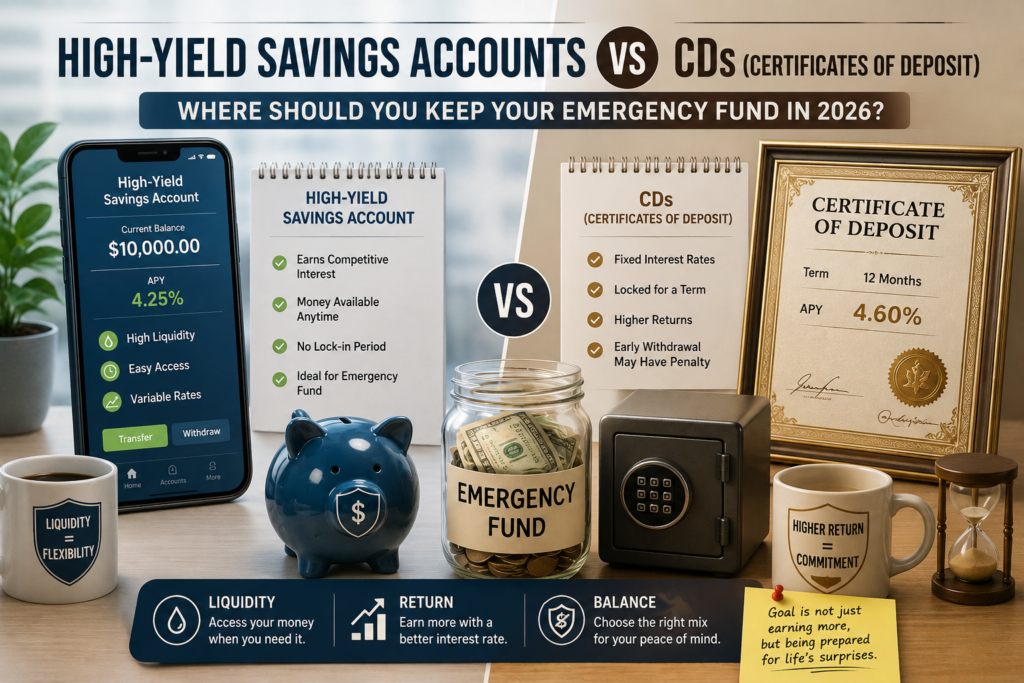
HYSA = more flexibility
CD = more rate certainty
A high-yield savings account is usually better when you want your emergency money available.
A CD can make sense when you know you will not need a particular portion of your money for a specific period.
Consider this example.
You have $15,000 in savings.
You could keep all $15,000 in a HYSA.
Or you could divide it:
$10,000 in HYSA + $5,000 in CDs
This second strategy may provide both liquidity and additional interest-rate certainty.
However, you should only put money into a CD if you understand its withdrawal rules and penalties.
Real Calculation Example: $10,000
Let’s compare a hypothetical HYSA and CD.
Suppose:
HYSA: 4.00% APY
CD: 4.50% APY
Starting money: $10,000
Approximate one-year interest:
HYSA: $10,000 × 4.00% = $400
CD: $10,000 × 4.50% = $450
Difference: $450 − $400 = $50
The CD earns about $50 more in this simplified example.
But ask yourself:
Is earning an additional $50 worth giving up some liquidity?
For an emergency fund, the answer may be no.
The purpose of emergency money is not to maximize every possible dollar of interest.
Its first job is to be available when something goes wrong.
Another Example: $25,000 Emergency Fund
Now imagine someone has a $25,000 emergency fund.
Suppose the HYSA pays a hypothetical 4% APY.
Approximate annual interest:
$25,000 × 4% = $1,000
Now suppose a CD pays 4.5%.
Approximate annual interest:
$25,000 × 4.5% = $1,125Difference:
$125 per year
Again, the CD provides a higher return in this example.
But the person needs to consider access to the money.
If the entire $25,000 is locked into CDs and an emergency happens tomorrow, accessing the money early could involve restrictions or an early withdrawal penalty.
That is why putting 100% of an emergency fund into CDs may not be the best strategy for many people.
Liquidity: Why It Matters for Emergency Money
Liquidity means how quickly and easily you can access your money without losing significant value or facing restrictions.
For an emergency fund, liquidity is extremely important.
Imagine you suddenly lose your job.
You may need money immediately for:
- Rent or mortgage
- Food
- Utilities
- Transportation
- Insurance
- Healthcare
- Other essential bills
You do not want to discover that your emergency money is difficult or expensive to access.
A HYSA generally provides easier access to your money than a CD.
A CD, depending on its terms, may require you to wait until maturity or pay an early withdrawal penalty.
Therefore, liquidity should usually be one of the first things you consider when choosing where to keep emergency savings.
When Does a High-Yield Savings Account Make Sense?
A HYSA can make sense when:
1. You want easy access
If you may need your emergency fund at any time, a savings account can be useful.
2. You do not want to lock your money
You can keep your money available instead of committing it for six months or one year.
3. Your income is uncertain
People with variable income may want more cash flexibility.
4. You are still building your emergency fund
If you are starting from zero, a HYSA can be a simple place to build your emergency savings.
5. You value flexibility more than maximum interest
The highest possible return is not always the most important goal for emergency money.
When Can a CD Make Sense?
A CD can make sense when:
1. You have money you know you will not need soon
If you have savings beyond your immediate emergency needs, a CD may be worth considering.
2. You want a fixed rate
A fixed-rate CD can provide more certainty about the return during its term.
3. You are comfortable with limited access
You understand the withdrawal rules and are willing to keep the money deposited until maturity.
4. You already have liquid emergency savings
This is important.
If you already have several months of expenses in an easily accessible savings account, additional savings may be suitable for other options depending on your financial goals.
A Better Strategy: Don’t Put Everything in One Place
For some people, the best answer may not be HYSA vs CD.
It may be:
HYSA + CDs
For example, suppose your target emergency fund is $18,000.
You could consider a structure such as:
$10,000–$12,000 in a HYSA
and$6,000–$8,000 in short-term CDs
This is only an example, not a universal recommendation.
The idea is to keep enough money immediately available while potentially earning a higher or more predictable return on money you are less likely to need immediately.
Another strategy is a CD ladder.
What Is a CD Ladder?
A CD ladder means dividing your money among CDs with different maturity dates.
For example, suppose you have $12,000 that you do not expect to need immediately.
Instead of putting all $12,000 into one 12-month CD, you could divide it into several smaller CDs with different maturity dates.
For example:
- $3,000 — shorter-term CD
- $3,000 — another maturity date
- $3,000 — another maturity date
- $3,000 — another maturity date
When one CD matures, you can decide whether to use the money or reinvest it.
This approach can provide more flexibility than putting everything into a single long-term CD.
However, CD ladders still require careful planning, and they should not replace the portion of an emergency fund that you need immediately accessible.
Safety Matters More Than Chasing the Highest Rate
When choosing an emergency fund account, don’t look only at the APY.
Also consider:
- Deposit insurance
- Account fees
- Minimum balance requirements
- Withdrawal rules
- Transfer times
- Early withdrawal penalties
- Rate changes
- Bank reputation
- Account terms
For U.S. savers, checking whether deposits are covered by FDIC insurance is an important safety consideration when using an FDIC-insured bank.
The goal of an emergency fund is stability.
You should not take unnecessary risk just to earn a little more interest.
Don’t Confuse an Emergency Fund With an Investment Account
An emergency fund has a different purpose from an investment portfolio.
Investments such as stocks can potentially provide higher long-term returns, but their value can fall.
Imagine you have $15,000 invested in stocks.
Then the market falls 25% at exactly the time you lose your job.
Your $15,000 could temporarily become approximately:
$11,250
If you urgently need $15,000, you may be forced to sell when prices are down.
That is one reason emergency savings are generally kept in safer and more liquid places rather than invested aggressively.
What About Taxes?
Interest earned from savings accounts and CDs may generally be taxable income in the United States.
This means the amount you earn is not necessarily the same as the amount you keep after taxes.
For example, suppose your account earns $500 in interest.
Your actual after-tax amount can be lower depending on your tax situation.
This is another reason to compare accounts based on their overall value rather than simply looking at the advertised APY.
Tax rules can change, so consider your individual situation and consult a qualified tax professional if you need personalized tax advice.
Common Mistakes to Avoid
Mistake 1: Keeping Emergency Money in Cash at Home
Cash at home can be useful in very limited situations, but keeping your entire emergency fund physically at home creates risks such as theft, loss, or damage.
Mistake 2: Locking the Entire Emergency Fund Into CDs
A CD can provide attractive interest, but putting all your emergency money into CDs may reduce flexibility.
Mistake 3: Chasing the Highest APY
A slightly higher APY may not be worth it if the account has poor terms, restrictions, or other problems.
Mistake 4: Ignoring Interest Rate Changes
Savings account rates can change.
A rate that looks excellent today may not remain the same forever.
Mistake 5: Having No Emergency Fund
Even the best savings account cannot help if you have no emergency savings at all.
Building the fund is more important than finding the perfect account.
So, Where Should You Keep Your Emergency Fund in 2026?
For many people, a High-Yield Savings Account is the simplest starting point for an emergency fund because it combines liquidity with the potential to earn more interest than a traditional savings account.
CDs can also have a place in a broader savings strategy, especially when you have money that you do not expect to need immediately and want greater rate certainty.
A possible approach is:
First layer: Keep your immediate emergency money in a HYSA.Second layer: If you have additional emergency savings, consider short-term CDs or a CD ladder if the terms fit your needs.
For example, if your emergency fund target is $18,000, you might keep a large portion immediately accessible and place a smaller portion into short-term CDs.
The exact split depends on your job stability, monthly expenses, income, debt, family responsibilities, and personal comfort with liquidity.
Final Verdict: HYSA vs CDs
There is no single answer that works for everyone.If your priority is access, a high-yield savings account is usually the stronger choice.
If your priority is locking in a rate on money you know you will not need for a set period, a CD may make more sense.
For many savers, the smartest approach can be a combination of both.
Think about your emergency fund in this order:
1. Safety
2. Liquidity
3. Return
Do not reverse that order.
An emergency fund is not designed to make you rich.
It is designed to protect you from financial emergencies.
If your money earns a reasonable return while remaining safe and accessible, you are already doing something valuable.
Frequently Asked Questions
Is a high-yield savings account better than a CD for an emergency fund?
For many people, yes. A HYSA usually provides easier access to money, which is important during an emergency. A CD may provide a higher or fixed rate but can have restrictions on early withdrawals.
Can I put my entire emergency fund into a CD?
You can, depending on the CD and institution, but it may not be ideal. An emergency can happen at any time, so keeping at least part of your emergency fund highly liquid can provide more flexibility.
How much should I keep in a high-yield savings account?
A common goal is three to six months of essential expenses. However, your ideal amount depends on your income stability, expenses, family situation, debt, and financial responsibilities.
Is CD interest guaranteed?
For a fixed-rate CD, the interest rate is generally fixed for the agreed term, subject to the account’s terms. Always read the specific CD agreement before depositing money.
Can I lose money in a CD?
A bank CD is generally designed to return your principal plus interest when held according to its terms, but early withdrawal can result in penalties. Deposit insurance and the specific institution’s terms also matter.
Should I use a CD or HYSA for my first $1,000 emergency fund?
A HYSA may be more practical because you may need that money quickly. Once you have built a sufficient liquid emergency reserve, you can consider other options for additional savings.
What is more important: APY or liquidity?
For an emergency fund, liquidity is usually more important than squeezing out the highest possible APY. The money needs to be available when an unexpected expense occurs.
FINAL
High-Yield Savings Accounts and CDs can both be useful, but they serve different purposes.
A HYSA focuses on flexibility and access.
A CD focuses more on rate certainty and a fixed savings period.
If you are building your emergency fund today, start by asking one simple question:
“If I needed this money tomorrow, could I access it easily?”
If the answer is yes, you are moving in the right direction.
And remember: the best emergency fund is not necessarily the one that earns the highest interest.
It is the one that is safe, accessible, and large enough to protect you when life does not go according to plan.