Meta tital
Understanding the Green Economy – Build a Sustainable Future Easily
Meta Description
Learn about the green economy in simple English. Discover how renewable energy, eco-friendly businesses, and sustainable development can create a better and cleaner future for everyone.
The world is changing rapidly. For decades, our global economy has relied on “taking, making, and wasting.” We take raw materials from the earth, make products, and then throw them away. This traditional model has led to significant wealth for some, but it has also caused massive pollution, climate change, and the loss of natural habitats.
Today, we are talking about a different path: the Green Economy. But what does that actually mean? Simply put, a green economy is one that results in improved human well-being and social equity, while significantly reducing environmental risks and ecological scarcities. It is an economy that is low-carbon, resource-efficient, and socially inclusive.
In this article, we will explore the “how” of the green economy. How does it work? How do we transition to it? And how does it affect our daily lives?
How Does a Green Economy Differ from a Traditional Economy?
To understand the “how,” we first need to look at the “what.” In a traditional economy, success is often measured solely by Gross Domestic Product (GDP)—the total value of goods and services produced. It doesn’t usually account for the “hidden costs” like air pollution, water contamination, or the health problems caused by factories.
In a green economy, the focus shifts. It asks: How can we grow without destroying the planet? ### The Triple Bottom Line the green economy operates on a principle often called the “Triple Bottom Line.” This means businesses and governments look at three things:
- Profit: Economic viability and growth.
- People: Social justice, health, and fair wages.
- Planet: Environmental protection and restoration.
Instead of just looking at a bank balance, a green economy looks at the health of the forest, the cleanliness of the air, and the happiness of the workers.
How Do We Produce Energy Sustainably?
The biggest engine of any economy is energy. Currently, most of our energy comes from burning fossil fuels like coal, oil, and gas. This process releases carbon dioxide (CO_2), which traps heat in the atmosphere and causes global warming.
The Shift to Renewables
How do we stop relying on fossil fuels? The answer lies in renewable energy. These are sources of power that do not run out and produce little to no pollution.
- Solar Power: Using panels to capture sunlight and turn it into electricity.
- Wind Power: Using large turbines to capture the energy of the wind.
- Hydroelectric Power: Using the movement of water in rivers or dams.
- Geothermal Energy: Using the heat from inside the Earth.
Improving Energy Efficiency
It isn’t just about where the energy comes from; it’s also about how we use it. Energy efficiency means using less energy to perform the same task. This includes:
- Building “green buildings” with better insulation so they stay warm in winter and cool in summer without extra heating or AC.
- Switching to LED light bulbs which use a fraction of the electricity of old bulbs.
- Manufacturing machines that do more work with less power.
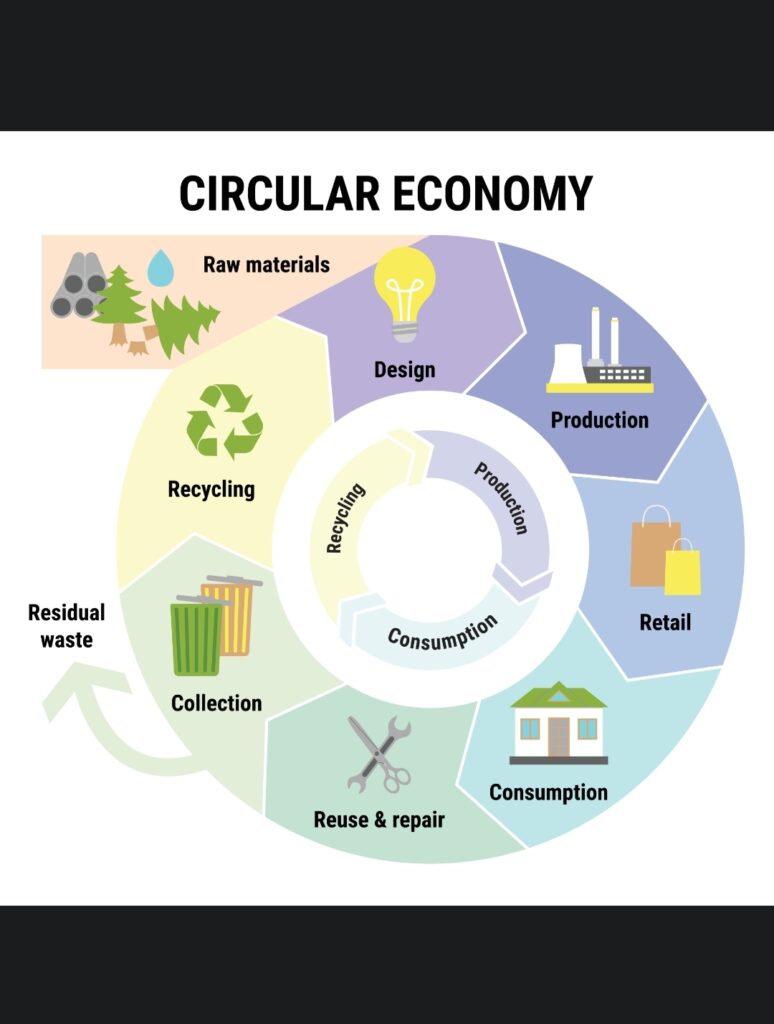
How Does the “Circular Economy” Work?
In our current system, we follow a linear path: Extract -> Manufacture -> Dispose. The green economy proposes a Circular Economy.
How does a circular economy function? It mimics nature. In a forest, there is no “waste.” A dead leaf falls, decays, and becomes food for the soil. A circular economy tries to do the same with human products.
- Design for Longevity: Products are made to last a long time and are easy to repair.
- Recycle and Reuse: Instead of throwing a broken phone away, the valuable metals inside (like gold and copper) are taken out and used to make a new one.
- Sharing Systems: Instead of everyone owning a car that sits idle 90% of the time, we use car-sharing apps. This reduces the number of cars that need to be manufactured.
How Can We Change Our Food and Agriculture Systems?
Agriculture is a massive part of the global economy, but it is also a major source of pollution. Traditional industrial farming often uses heavy chemicals and uses vast amounts of water.
How do we make farming green?
- Regenerative Agriculture: This is a way of farming that actually improves the soil. By rotating crops and avoiding harsh chemicals, farmers can help the soil absorb more carbon from the air.
- Reducing Meat Consumption: Producing beef requires a lot of land and water. By eating more plant-based foods, we reduce the pressure on the planet’s resources.
- Local Food Systems: How much fuel is burned to fly a strawberry halfway across the world? By buying food grown near our homes, we reduce the carbon footprint of our meals.
How Does a Green Economy Create Jobs?
A common fear is that “going green” will kill jobs in industries like coal mining or oil drilling. While some old jobs will disappear, many more will be created. These are often called Green-Collar Jobs.
How are these new jobs created?
- Installation and Maintenance: We need millions of workers to install solar panels and maintain wind turbines.
- Retrofitting: We need construction workers to update old buildings to make them energy-efficient.
- Innovation: We need scientists and engineers to invent better batteries and cleaner ways to make steel and cement.
- Public Transit: Expanding bus and train networks creates jobs for drivers, mechanics, and planners.
According to many international reports, the transition to a green economy could create up to 24 million new jobs globally by 2030.
| Topic | Explanation |
|---|---|
| Green Economy | An economy focused on protecting the environment and saving natural resources |
| Sustainable Future | Creating a better future without harming nature |
| Renewable Energy | Energy from solar, wind, and water sources |
| Green Jobs | Jobs that help protect the environment |
| Eco-Friendly Businesses | Companies using sustainable and clean methods |
| Environmental Protection | Reducing pollution and saving nature |
| Recycling | Reusing materials to reduce waste |
| Clean Transportation | Electric vehicles and public transport solutions |
| Energy Efficiency | Using less energy to save money and resources |
| Climate Change Action | Steps taken to reduce global warming |
How Do Governments Lead the Way?
Individual choices matter, but big change requires big rules. How do governments encourage a green economy?
1. Carbon Pricing
Governments can put a price on pollution. If a factory has to pay a tax for every ton of CO_2 it emits, it has a financial reason to find cleaner ways to operate.
2. Ending Harmful Subsidies
Currently, many governments give money (subsidies) to oil and gas companies to keep fuel prices low. A green economy involves moving that money to support solar, wind, and electric vehicles instead.
3. Green Regulations
Governments can pass laws that ban single-use plastics or require all new cars sold after a certain year to be electric.
How Do We Ensure “Social Equity”?
One of the most important “hows” of the green economy is: How do we make sure no one is left behind? This is called a Just Transition.
If a coal mine closes, the workers shouldn’t just be fired. A green economy provides:
- Retraining Programs: Helping mine workers learn how to work in renewable energy.
- Affordable Technology: Making sure electric cars and solar panels aren’t just for rich people, but are accessible to everyone.
- Global Cooperation: Richer nations helping developing nations pay for green technology so they can grow without relying on coal.
How Can You Contribute?
You might ask, “How can I, as one person, help the green economy?” While the big changes happen at the government and corporate levels, your choices drive the market.
- Change your habits: Use public transport, bike, or walk. Reduce your meat intake.
- Be a conscious consumer: Support companies that use recycled materials or have fair-labor practices.
- Speak up: Use your voice to tell leaders that you want green policies.
- Reduce waste: Follow the “Refuse, Reduce, Reuse, Recycle” rule.
Conclusion: How Does the Future Look?
The transition to a green economy is not just a “nice idea”—it is a necessity. Our current way of living is stretching the Earth’s resources to a breaking point.
How will the future look if we succeed?
Imagine cities with clean air where you can breathe deeply without coughing. Imagine oceans free of plastic and forests that are growing instead of shrinking. Imagine a world where the economy provides a good life for everyone without costing us the earth.
The path to a green economy is complex and requires hard work. It requires us to rethink how we travel, how we eat, and how we value the world around us. But by asking “how” and taking action today, we can build a future that is not only sustainable but also more prosperous and fair for generations to come.
The green economy is more than just “saving the planet.” It is about building a smarter, better way to live. How will you start your journey today?
FAQ Question
What is a green economy?
A green economy is a system that supports economic growth while protecting the environment.
Why is a sustainable future important?
A sustainable future helps save natural resources and creates a healthier life for future generations.
How does renewable energy help the environment?
Renewable energy reduces pollution and lowers dependence on fossil fuels.
What are green jobs?
Green jobs are careers that support environmental protection and sustainable development.
How can people support the green economy?
People can recycle, save energy, use public transport, and support eco-friendly products.