The Ultimate Easy Guide to AI Trading Bots: Trade Like a Pro in 2026
Learn how AI trading bots work in 2026 and discover the best strategies, tools, benefits, risks, and tips to trade like a pro. Perfect for beginners and advanced traders.
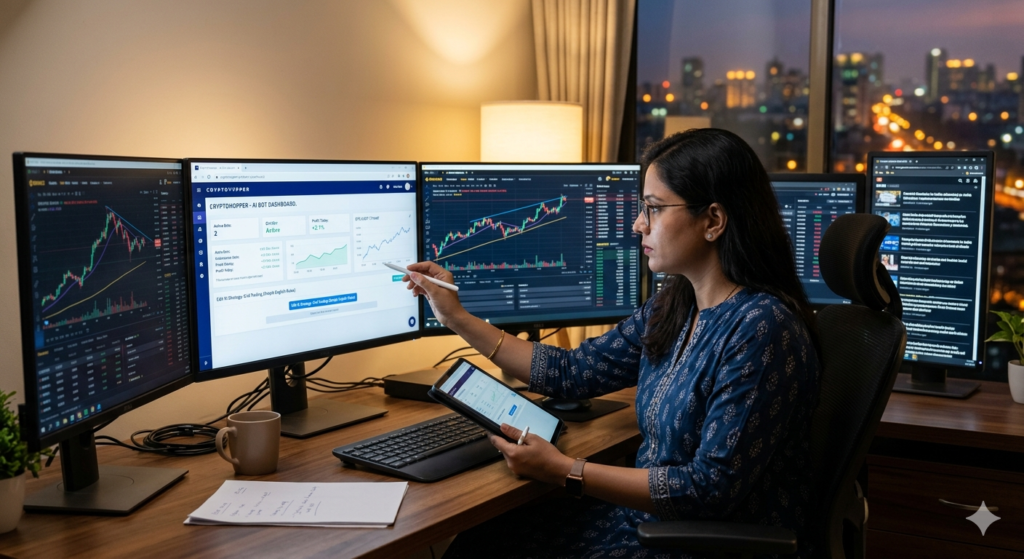
The world of investing is changing fast. If you have ever felt overwhelmed by the constant movement of the stock or crypto markets, you are not alone. It is impossible for a human being to watch price charts 24 hours a day, 7 days a week. This is where AI trading bots come in.
In this article, we will answer all your “how-to” questions about AI trading. We will explain what these bots are, how they work, and how you can start using one today—all in simple English.
How do AI trading bots actually work?
At its simplest, an AI trading bot is a computer program that buys and sells assets for you. Unlike a standard “algorithmic” bot, which only follows basic instructions like “buy when the price hits $100,” an AI bot uses Machine Learning (ML).
How does this make a difference? It means the bot can learn from the data it sees. Here is the process in three steps:
- Data Collection: The bot scans millions of data points every second. This includes price history, trading volume, social media trends (sentiment analysis), and even global news.
- Analysis: Using its “brain” (the AI model), it looks for patterns. It asks, “The last ten times the market looked like this, did the price go up or down?”
- Execution: Once it identifies a high-probability opportunity, it places the trade instantly—much faster than you could click a mouse.
How can AI trading help you?
You might wonder why you should let a machine handle your hard-earned money. Here are the primary benefits:
- Trading without emotion: Humans get scared when prices drop and greedy when they rise. This leads to bad decisions. A bot has no feelings; it only follows the logic of its data.
- 24/7 Market Coverage: While you sleep, eat, or work, the bot is watching the markets. This is especially important in the crypto world, which never closes.
- Speed: In 2026, the markets move in milliseconds. AI bots can execute trades the moment a pattern appears, giving you an edge over manual traders.
How do you choose the right AI trading bot?
With so many options available, choosing your first bot can be tricky. You should ask yourself these four questions before signing up:
1. How much does it cost?
Some bots charge a monthly subscription (like $20 to $100), while others take a small percentage of your profits. Beginners should look for bots with a “free tier” or a low flat fee.
2. Is it easy to use?
If you are not a computer programmer, you do not want a bot that requires writing code. Look for “No-Code” platforms that use simple “if-this-then-that” rules.
3. Does it support your exchange?
A bot is useless if it cannot talk to your trading account. Ensure the bot connects to popular platforms like Binance, Coinbase, or E*TRADE.
4. What is the security like?
Never give a bot permission to “withdraw” your funds. It should only have permission to “trade.” This keeps your money safe in your own account.
How to set up your first AI trading bot (Step-by-Step)
Setting up a bot is easier than you might think. Follow these five steps to get started:
Step 1: Pick your platform
For beginners in 2026, platforms like Pionex, 3 Commas, or Cryptohopper are great choices. For stocks, Trade Ideas is a top-rated AI option.
Step 2: Connect via API
You don’t send your money to the bot. Instead, you connect the bot to your exchange account using an API Key. Think of an API key as a special “digital key” that lets the bot enter the room and move things around (trade) without having the key to the safe (withdrawals).
Step 3: Choose a strategy
Most bots come with pre-set strategies. For a beginner, a Grid Trading Bot is a safe place to start. It buys small amounts when the price drops and sells small amounts when the price rises, profiting from the “sideways” movement of the market.
Step 4: Use “Paper Trading” first
Before you use real money, use a “Paper Trading” or “Demo” account. This lets the bot trade with fake money so you can see how it performs in the real market without any risk.
Step 5: Start small and monitor
Once you are confident, start with a small amount of money. Even though it is “automated,” you should check on your bot once a day to ensure the market hasn’t changed in a way the bot wasn’t prepared for.
Benefits of AI trading bot
Benefits of AI Trading Bots
| Benefit | Description |
|---|---|
| Faster Trading | Executes trades instantly |
| 24/7 Operation | Monitors markets all day |
| Emotion-Free Trading | Reduces fear and greed |
| Smart Analysis | Uses AI and machine learning |
| Better Accuracy | Detects patterns quickly |
| Time Saving | Automates repetitive tasks |
| Risk Management | Uses stop-loss and alerts |
| Multi-Market Trading | Works with crypto, forex, and stocks |
How do different AI strategies work?
There is no “one size fits all” strategy. Here are the three most common ways AI bots trade:
How to manage the risks of AI trading
Is AI trading a “get rich quick” scheme? Absolutely not. Even the smartest AI can lose money if the market crashes unexpectedly. Here is how to stay safe:
- Set a “Stop-Loss”: This is an instruction that tells the bot to sell everything if the price drops by a certain percentage (like 5% or 10%). This prevents a small loss from becoming a total disaster.
- Beware of “Hallucinations”: Sometimes AI models “see” patterns that aren’t really there. This is why you must always oversee your bot.
- Don’t over-leverage: Avoid using “leverage” (borrowed money) when starting. It multiplies your gains but also multiplies your losses.
How will AI trading change in the future?
As we move through 2026, AI is becoming more “conversational.” We are seeing the rise of AI Trading Assistants. Instead of clicking buttons, you can simply type, “Hey Bot, find me three stocks that are undervalued and have positive news on Twitter, then buy $100 of each.”
The technology is also becoming better at “Reinforcement Learning.” This means the bot “practices” millions of trades in a simulation before it ever touches your real money, making it much smarter than the bots of a few years ago.
Frequently Asked Questions (FAQ)
How much money do I need to start?
Many bots allow you to start with as little as $10 or $50. However, keep in mind that trading fees might eat into your profits if your balance is too small.
Is AI trading legal?
Yes, using a bot to trade is completely legal in most countries. However, you are still responsible for paying taxes on any profits you make.
Can a bot guarantee a profit?
No. No technology can predict the future with 100% accuracy. A bot is a tool to help you make better decisions, not a magic money machine.
Do I need to be a math genius?
Not at all. In 2026, the user interfaces are designed for regular people. If you can use a smartphone app, you can use a trading bot.
AI trading bot comparison
AI Trading Bots vs Traditional Trading
| Feature | Traditional Trading | AI Trading Bots |
|---|---|---|
| Trading Speed | Manual execution | Automated instant execution |
| Market Monitoring | Limited hours | 24/7 monitoring |
| Emotional Decisions | High | Low |
| Data Analysis | Human analysis | AI-powered analytics |
| Accuracy | Depends on trader | Pattern-based predictions |
| Automation | Minimal | Fully automated |
| Risk Management | Manual | Smart AI controls |
| Trading Efficiency | Moderate | High |
| Strategy Testing | Time-consuming | Fast backtesting |
| Scalability | Limited | Easily scalable |
Summary: How to succeed with AI trading
To wrap it up, AI trading bots are powerful tools that can save you time and remove the stress of emotional trading. To succeed, you should:
- Start simple with a user-friendly platform.
- Test everything with fake money (paper trading) first.
- Protect yourself with stop-loss orders.
- Stay involved—treat the bot like an employee you need to manage, not a replacement for your brain.
By following these steps, you can use the power of artificial intelligence to navigate the complex world of finance with more confidence and less stress. Happy trading!
FAQ Question
Frequently Asked Questions About AI Trading Bots
1. What is an AI trading bot?
An AI trading bot is automated software that uses artificial intelligence and market data to buy or sell assets like stocks, forex, or cryptocurrency.
2. Are AI trading bots profitable in 2026?
AI trading bots can be profitable when used with proper strategies, risk management, and market analysis, but profits are never guaranteed.
3. Can beginners use AI trading bots?
Yes, many AI trading platforms are beginner-friendly and offer automated settings, copy trading, and easy dashboards.
4. Which markets can AI bots trade?
AI bots can trade cryptocurrencies, stocks, forex, commodities, and ETFs depending on the platform.
5. Are AI trading bots safe?
Most trusted bots are safe when connected to secure exchanges and protected with API security, but users should avoid scams and unrealistic profit promises.
6. Do AI trading bots work 24/7?
Yes, AI trading bots can monitor markets and execute trades continuously without human intervention.
7. What are the risks of AI trading bots?
Major risks include market volatility, technical errors, over-optimization, and poor trading strategies.
8. Can AI trading bots predict the market?
AI bots analyze patterns and trends but cannot predict markets with 100% accuracy.