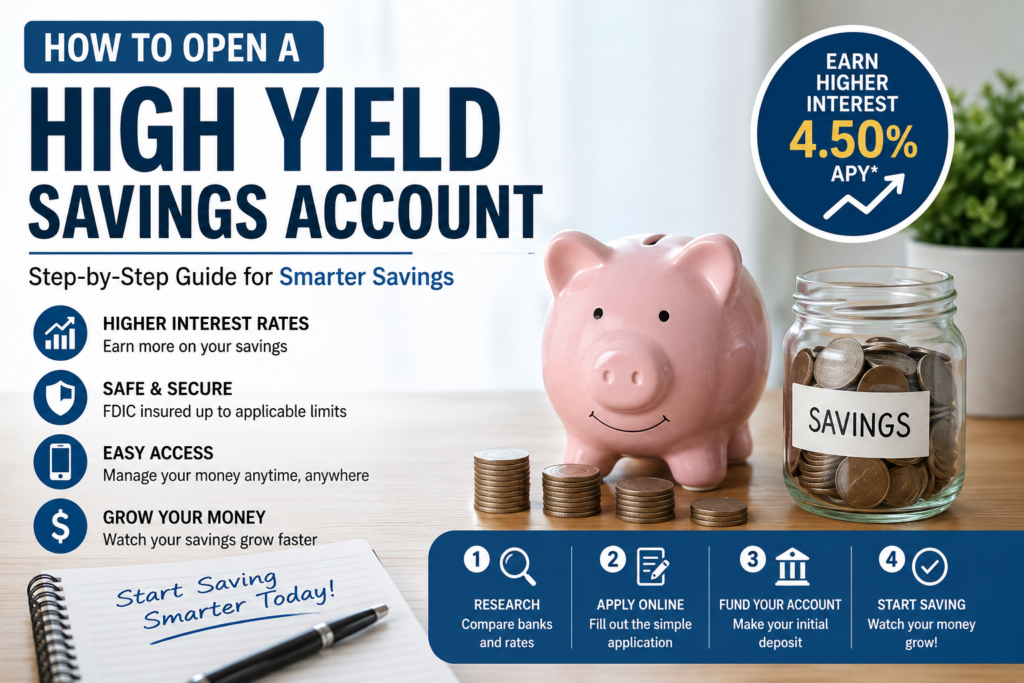
How to Open a High Yield Savings Account in 2026 | Complete Beginner Guide
Learn how to open a high yield savings account step-by-step in 2026. Discover benefits, requirements, tips, fees, and how to choose the best HYSA for maximum savings growth.
In today’s financial world, saving money is no longer just about putting cash aside in a traditional bank account. Smart savers are looking for better ways to grow their money while keeping it safe and easily accessible. One of the best options available is opening a High Yield Savings Account (HYSA).
A high yield savings account offers significantly higher interest rates compared to regular savings accounts, helping your money grow faster over time. If you are wondering how to open a high yield savings account, this detailed guide will walk you through everything you need to know, including benefits, requirements, steps, and tips for choosing the best account.
What Is a High Yield Savings Account?
A high yield savings account is a type of savings account that pays a much higher annual percentage yield (APY) than standard savings accounts offered by traditional banks.
While regular savings accounts may offer interest rates as low as 0.01% to 0.10% APY, high yield savings accounts can offer 3% to 5% APY or more, depending on the bank and market conditions.
These accounts are typically offered by:
- Online banks
- Credit unions
- Digital financial institutions
- Some traditional banks
The biggest advantage is that your money earns more interest while remaining secure and accessible.
Benefits of Opening a High Yield Savings Account
Before learning how to open one, it’s important to understand why high yield savings accounts are popular.
1. Higher Interest Earnings
The primary benefit is earning more money through interest.
For example:
- $10,000 in a traditional savings account at 0.05% APY earns about $5 annually
- $10,000 in a high yield savings account at 4.50% APY earns about $450 annually
That is a huge difference.
2. Safe and Secure
Most reputable banks offering high yield savings accounts are insured by:
- FDIC (Federal Deposit Insurance Corporation) for banks
- NCUA (National Credit Union Administration) for credit unions
This insurance typically protects deposits up to applicable limits.
3. Easy Access to Funds
You can usually access your money through:
- Online transfers
- Mobile apps
- ATM access (in some cases)
- Linked checking accounts
4. No Market Risk
Unlike investing in stocks or crypto, your money does not fluctuate in value.
5. Helps Build Financial Discipline
A separate savings account encourages better money management and supports financial goals.
Who Should Open a High Yield Savings Account?
A high yield savings account is ideal for:
Emergency Fund Builders
Perfect for storing emergency savings while earning interest.
Short-Term Goal Savers
Great for:
- Vacations
- Buying a car
- Wedding expenses
- Education fees
Beginners
Low-risk and easy to manage.
Conservative Investors
Ideal if you prefer stable returns.
Requirements to Open a High Yield Savings Account
Most banks require basic information and documentation.
Personal Information
You’ll typically need:
- Full legal name
- Date of birth
- Address
- Phone number
- Email address
Identification
A government-issued ID such as:
- Passport
- Driver’s license
- National ID card
Social Security Number or Tax ID
Depending on your country.
Initial Deposit
Some banks require:
- No minimum deposit
- $25 to $500 minimum opening deposit
Existing Bank Account
You may need another bank account to transfer funds.
Step-by-Step: How to Open a High Yield Savings Account
Step 1: Research Different Banks
Start by comparing different financial institutions.
Look for:
- Interest rates (APY)Fees
- Minimum balance requirements
- Mobile banking features
- Withdrawal limits
- Customer support
Popular providers often include online banks because they usually offer higher rates.
Step 2: Compare Interest Rates
Not all high yield savings accounts offer the same APY.
Compare:
- Current APY
- Introductory promotional rates
- Variable vs fixed rates
Choose accounts with competitive long-term returns.
Step 3: Check for Fees
Avoid accounts with:
- Monthly maintenance fees
- Withdrawal penalties
- Excess transaction charges
- Account closure fees
The best high yield savings accounts often have zero monthly fees.
Step 4: Review Minimum Balance Requirements
Some accounts require you to maintain a minimum balance.
Examples:
- No minimum balance
- $100 minimum
- $1,000 to avoid fees
Choose based on your savings capacity.
Step 5: Visit the Bank Website
Once you choose a provider:
- Go to the official website
- Click Open Account
- Select High Yield Savings Account
Most applications are completed online in 10–15 minutes.
Step 6: Fill Out the Application Form
Provide requested details:
- Personal information
- Identification details
- Employment information (if required)
- Tax details
Ensure all information is accurate.
Step 7: Verify Your Identity
Banks may ask for:
- Photo ID upload
- Address proof
- Security questions
- SMS verification code
This is part of fraud prevention.
Step 8: Link an External Bank Account
To fund your new account, connect your current bank account.
This usually requires:
- Account number
- Routing number
- Verification deposit confirmation
Step 9: Make Your Initial Deposit
Transfer the required opening amount.
Funding methods may include:
- Bank transfer
- Debit card
- Wire transfer
- Mobile deposit
Step 10: Set Up Online Access
Create:
- Username
- Password
- Two-factor authentication
Download the bank’s mobile app for easier management.
High Yield Savings Account Comparison Table
| Feature | Traditional Savings Account | High Yield Savings Account |
|---|---|---|
| Interest Rate (APY) | Very Low | Much Higher |
| Best For | Basic Savings | Faster Savings Growth |
| Online Access | Limited | Strong Digital Banking |
| Monthly Fees | Sometimes | Often No Fees |
| Minimum Balance | Varies | Usually Low |
| Compound Interest | Basic | Higher Earnings |
| Emergency Fund Use | Good | Excellent |
| Risk Level | Very Low | Very Low |
Tips for Choosing the Best High Yield Savings Account
Prioritize High APY
Higher APY means faster savings growth.
Choose No-Fee Accounts
Fees can reduce your earnings.
Look for Easy Withdrawals
Ensure you can access your funds when needed.
Read Customer Reviews
Look for feedback on:
- Customer service
- App performance
- Reliability
Check Compound Frequency
Interest may compound:
- Daily
- Monthly
- Quarterly
Daily compounding generally earns slightly more.
Common Mistakes to Avoid
Choosing Based Only on APY
A high APY is great, but check for hidden fees.
Ignoring Withdrawal Restrictions
Some banks limit monthly withdrawals.
Not Reading Terms and Conditions
Understand account rules before signing up.
Leaving the Account Unfunded
An empty account won’t generate returns.
How Much Money Should You Deposit?
This depends on your financial goals.
Suggested starting amounts:
Beginners: $100–$500
Emergency Fund: 3–6 months of expenses
Short-Term Goals: Based on target amount
Consistency matters more than starting big.
How High Yield Savings Accounts Grow Money
Here’s a simple example:
Initial Deposit: $5,000
APY: 4.5%
Time: 5 years
With compound interest, your savings could grow significantly without additional effort.
The earlier you start, the more you benefit.
Are High Yield Savings Accounts Worth It?
Yes, for most savers they are absolutely worth it.
They provide:
- Better returns than regular savings
- Safety
- Liquidity
- Simplicity
If your money is sitting in a low-interest account, switching to a high yield savings account can help maximize growth.
Steps of high yield saving account
| Step | Action |
|---|---|
| 1 | Research and compare banks |
| 2 | Check APY and account fees |
| 3 | Review minimum balance requirements |
| 4 | Fill out online application |
| 5 | Upload ID verification documents |
| 6 | Link your existing bank account |
| 7 | Deposit initial funds |
| 8 | Activate online/mobile banking |
Frequently Asked Questions
Is a High Yield Savings Account Safe?
Yes, if offered by insured financial institutions.
Can I Lose Money?
Generally no, unless there are fees that reduce your balance.
How Long Does It Take to Open One?
Usually 10–20 minutes online.
Can I Have Multiple High Yield Savings Accounts?
Yes, many people open separate accounts for different goals.
Do I Pay Taxes on Interest Earned?
Yes, interest earnings may be taxable depending on your country.
Final Thoughts
Opening a high yield savings account is one of the smartest financial moves for anyone looking to grow savings safely and efficiently.
The process is simple:
- Research banks
- Compare APYs
- Review fees
- Complete application
- Fund account
- Start saving
By choosing the right account and depositing regularly, you can build wealth steadily over time.
If your goal is to make your money work harder without taking investment risks, a high yield savings account is an excellent choice.