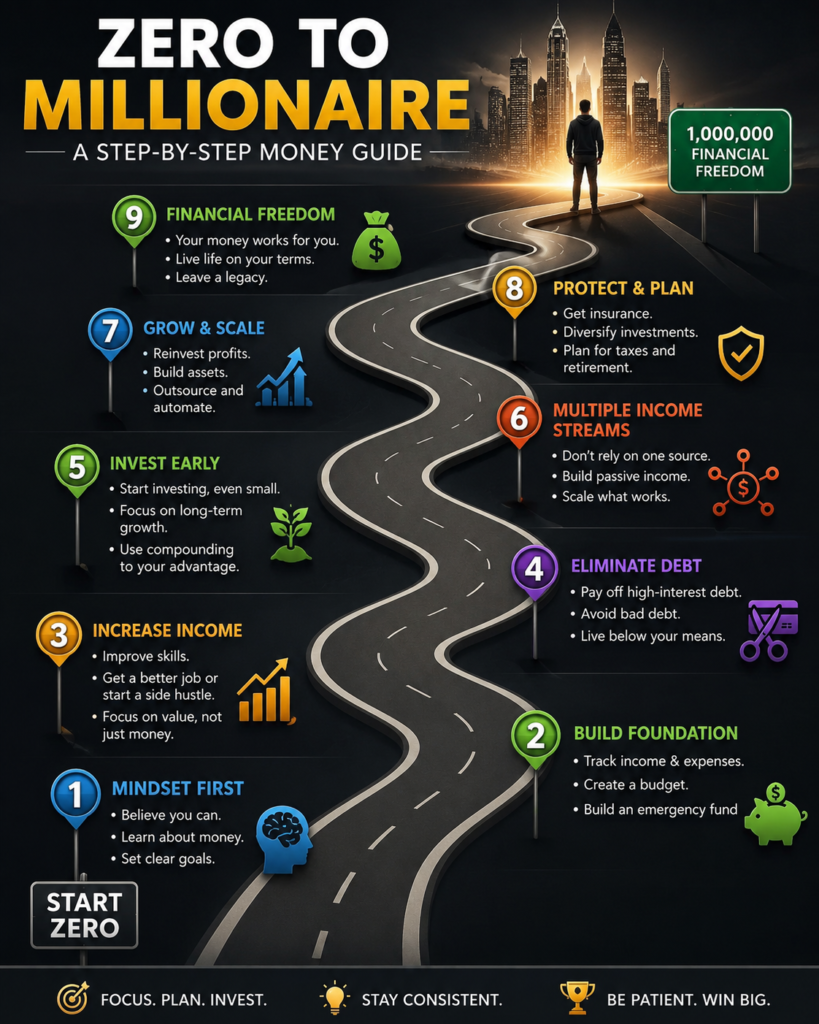
What if your salary stopped tomorrow? Would you survive six months without borrowing money? If the answer is no, this guide will show you exactly how to build financial freedom in 2026.
Many People dream of financial freedom but feel overwhelmed by where to start. The good news that you don’t need to be rich or financial expert to being. Financial freedom simply means having enough money live life you want without constantly worrying about bills, debt or unexpected experience. This article will guide you through a simple, step by step money plan that anyone can follow. Where you are a student, young professional, or someone looking to take control of your finances, this plan design to help you build a strong foundation for a secure future.
Personal Finance is often treated like a complex branch of physics, filled with terminology, intimidating spreadsheets, and the looming fear of “doing it wrong.” But at its core, managing your money isn’t about being a math whiz—it’s about behavioral discipline and intentionality
Whether you are looking to dig yourself out of debt, save for your first home, or invest for a retirement that actually looks like a vacation, the principles remain the same. Here is your roadmap to mastering your financial life.
1.The Foundation: Mindset and Tracking
Before you open a high-yield savings account or pick a stock, you have to understand your “why.” Money is simply a tool to facilitate the life you want. If you don’t know what that life looks like, you’ll likely spend your tool on things that don’t matter
Know Your Numbers
You cannot manage what you do not measure. Tracking your net worth and your cash flow is the first step toward clarity.
- Net Worth: Total Assets (what you own) minus Total Liabilities (what you owe).
- Cash Flow: income minus Expenses.
Pro Tip: Don’t obsess over every penny. Instead, focus on the “Big Three” expenses: Housing, Transportation, and Food. If you can optimize these, the occasional $6 latte won’t break your future.

2. The Budgeting Frameworks
Forget the “B-word” as a form of restriction. Think of a budget as a spending plan that gives you permission to spend on what you love by cutting ruthlessly on what you don’t.
The 50/30/20 Rule
This is the gold standard for simplicity:
- 50% Needs: Rent/Mortgage, utilities, groceries, insurance. There are essential expenses like rent, groceries, utilise, transportation and minimum debt payment.
- 30% Wants: Dining out, hobbies, Netflix, travel. There are non essential think like dining out, entertainment, shoping and hobbies.
- 20% saving and Debt payment :Debt repayment, emergency fund, investments. This includes building an emergency fund, saving for retirement, and playing of extra debt.
if you find that you need take up more than 50% of your income, look way of reduce them. Maybe you find a cheaper place to live, cook mare meal at home or use public transport instead owning your car.
Zero-Based Budgeting
Popularized by the “envelope method,” every dollar is assigned a job at the start of the month. If you have $4,000 in income, you assign all $4,000 to various categories (including savings) until there is $0 left. It forces you to be honest about where your money is going.
3. The Defensive Strategy: Risk Management
Life is unpredictable. If your car breaks down or you lose your job, you don’t want to rely on high-interest credit cards.
The Emergency Fund
Target 3 to 6 months of essential expenses. Keep this money in a High-Yield Savings Account (HYSA). It shouldn’t be “invested” in the stock market because you need it to be liquid and stable. In 2026, with shifting economic climates, having this “peace of mind” fund is non-negotiable.
High-Interest Debt Elimination
Not all debt is created equal. Credit card debt is a financial emergency. If you are paying 20% interest, you are essentially in a “reverse investment” where your wealth is shrinking daily.
- Debt Avalanche: Pay off the highest interest rate first (mathematically superior).
- Debt Snowball: Pay off the smallest balance first (psychologically superior).
4. The Offensive Strategy: Investing for Growth
Once your “defensive” line is set (emergency fund and high-interest debt gone), it’s time to play offense. This is where wealth is actually built.
How much you should save ?
start with small goal of 1000 or 10,000 dollar. Ones you reach that, aim for 3 to 6 month live expenses. If you dependent or an unstable job, aim to 6 to 12 month.
where to keep it ?
keep your emergency fund in High yield savings account or a liquid fund. It should be easy to excess quickly but seperate for regular checking account so you are not tempted to spend it .
The Power of Compounding
The most valuable asset you have isn’t money; it’s time. The mathematical formula for compound interest demonstrates why starting early is vital:
A= p (1+ r/n)ne
Where:
- A: Final amount
- P: Principal balance
- r : Annual interest rate
- n : Number of times interest is compounded per year
Where to Put Your Money
1. 401(k) / Employer-Sponsored Plans
- The “Free Money” Factor: The biggest draw is the employer match. If your company offers a 3% match, that is an immediate 100% return on your investment before the market even moves.
- Tax Efficiency: Contributions are typically “pre-tax,” meaning they lower your taxable income for the year, allowing you to keep more of your paycheck now.
- Best For: Creating a high-volume retirement nest egg and reducing your current tax bill.

2. Roth IRA
- Tax-Free Future: Unlike a 401(k), you pay taxes on the money before you put it in. The tradeoff? Every dollar it earns, and every dollar you withdraw in retirement, is 100% tax-free.
- Flexibility: Since you already paid taxes on the principal, you can actually withdraw your contributions (not the earnings) at any time without penalty if an emergency strikes.
- Best For: Young investors or those who believe they will be in a higher tax bracket later in life.
3. Brokerage Account (Taxable)
- Ultimate Access: There are no age restrictions (like 59.5) to access this money. You can sell your stocks and withdraw the cash whenever you want
- No Contribution Limits: While IRAs and 401(k)s have annual caps, you can put as much money as you want into a brokerage account.
- Best For: “Bridge” money—funds you need for goals that are 5 to 10 years away, like a down payment on a house or early retirement.
4. HSA (Health Savings Account)
- The Triple Tax Advantage: This is arguably the most powerful account in existence.
- 1.Money goes in tax-free.
- 2.It grows tax-free.
- 3.Withdrawals for medical expenses are tax-free.
- The Hidden “IRA” Hack: After age 65, you can withdraw the money for anything (not just medical) and it simply acts like a traditional IRA.
- Best For: Anyone with a high-deductible health plan who wants to optimize their tax strategy for long-term healthcare costs.
Low-Cost Index Funds
You don’t need to find the next “unicorn” tech stock. Historically, the S&P 500 has returned roughly 7-10% annually over long periods. By buying a total market index fund, you are betting on the growth of the entire economy rather than a single company.
5. Avoiding the “Lifestyle Creep” Trap
Lifestyle creep (or lifestyle inflation) is the phenomenon where your spending increases as your income increases. You get a $10,000 raise, and suddenly you “need” a more expensive car and a bigger apartment.
To combat this, use the “Rule of Halves”: Every time you get a raise or a bonus, put 50% toward your future (savings/investing) and 50% toward your current lifestyle. This allows you to enjoy your success today without sabotaging your future self.
6. Psychology: The Invisible Barrier
Modern personal finance is 20% head knowledge and 80% behavior. Our brains are wired for immediate gratification—the “dopamine hit” of a new purchase.
Automation is Your Best Friend
The most successful savers are those who never see the money.
- Automate your 401(k) contributions from your paycheck
2. Automate a transfer to your HYSA on the day you get paid.
3. Automate your bill payments
When you remove the “decision-making” process, you remove the opportunity for your brain to talk you out of doing the right thing.
7. The Checklist for Success
If you’re feeling overwhelmed, follow these steps in order:
- Starter Emergency Fund: Save $1,000–$2,000 for minor hiccups
- The Match: Contribute to your employer-sponsored retirement plan enough to get the full company match
- Kill the Dragons: Pay off all high-interest debt (anything over 7-8%).
- Full Emergency Fund: Bulk up to 3-6 months of expenses.
- .15% for Retirement: Aim to invest 15% of your gross income for the long term
- Big Purchases: Save for a home, wedding, or education.
- Wealth and Generosity: Pay off the mortgage early and give back.
Conclusion: Starting is Better than Perfecting
The biggest mistake people make in personal finance is waiting for the “perfect” time to start. They wait for a bigger salary, for the market to dip, or for their “life to settle down.”
Financial freedom isn’t a destination you reach; it’s a series of small, boring habits practiced over decades. Start where you are, use what you have, and do what you can. Your future self will thank you for the compound interest you started building today.
Summary
Key Pillars of the Financial Roadmap
- The Foundation: Success begins with tracking cash flow and understanding your “why.” By managing the “Big Three” expenses—housing, transportation, and food—individuals can create significant financial margin without feeling deprived.
- Strategic Budgeting: The guide advocates for flexible frameworks like the 50/30/20 rule or Zero-Based Budgeting. These methods transform budgeting from a restrictive tool into a proactive spending plan.
- Defense First: Prioritizing an emergency fund (3–6 months of expenses) and aggressively eliminating high-interest debt serves as a protective barrier against economic volatility.
- Offensive Growth: Wealth is generated through compound interest and low-cost index funds. The article emphasizes starting early to maximize the mathematical advantage of time, utilizing tax-advantaged accounts like 401(k)s and Roth IRAs.
- Psychological Mastery: To counter “lifestyle creep” and the urge for instant gratification, the article suggests automating finances. Removing the need for daily decision-making ensures long-term consistency.
The Bottom Line
Financial independence is a marathon of “small, boring habits.” By prioritizing employer matches, debt elimination, and a consistent 15% investment rate, anyone can transition from financial stress to a position of security and generosity.
Disclaimer:
This article provides general financial education and does not constitute professional investment, legal, or tax advice. Always consult with a certified financial planner or tax professional regarding your specific situation.
FAQ Section
1. What is financial freedom?
Financial freedom means having enough money, savings, and investments to cover your lifestyle without depending completely on a monthly salary.
2. How can beginners start managing money in 2026?
Beginners can start by creating a budget, tracking expenses, saving regularly, and learning basic investing skills.
3. What is the best budgeting method in 2026?
The 50/30/20 rule is one of the best budgeting methods.
- 50% for needs
- 30% for wants
- 20% for savings and investments
4. Why is financial planning important?
Financial planning helps you control spending, reduce debt, prepare for emergencies, and achieve long-term goals.
5. How much money should I save every month?
Experts suggest saving at least 20% of your monthly income if possible.
6. What are the best investment options for beginners?
Popular beginner-friendly investments include:
- Mutual Funds
- SIPs
- Index Funds
- Fixed Deposits
- Gold Investments
7. What is financial freedom?
Financial freedom means having enough income, savings, and investments to cover your living expenses without relying entirely on a regular paycheck. It gives you the flexibility to make life decisions based on your goals rather than financial pressure.
8. How can I achieve financial freedom in 2026?
You can achieve financial freedom by creating a budget, eliminating high-interest debt, building an emergency fund, investing consistently, increasing your income, and maintaining disciplined spending habits.
9. How much money do I need to become financially free?
The amount depends on your lifestyle, monthly expenses, and long-term financial goals. Many experts recommend saving and investing enough to generate passive income that covers your annual living expenses.
10. What is the best investment for beginners?
For beginners, diversified index funds, ETFs, retirement accounts, and other low-cost investments are often considered good starting points. Always research your options and consider your risk tolerance before investing.
11. Why is an emergency fund important?
An emergency fund helps you handle unexpected expenses such as medical bills, job loss, or major repairs without relying on credit cards or loans.
12. Can I achieve financial freedom on an average salary?
Yes. Financial freedom is possible on an average income through consistent saving, smart budgeting, disciplined investing, and increasing your earning potential over time.
13. What are the biggest mistakes that delay financial freedom?
Common mistakes include overspending, carrying high-interest debt, failing to save regularly, not investing, and making emotional financial decisions.
14. How long does it take to achieve financial freedom?
The timeline varies depending on your income, savings rate, investments, and financial habits. With a clear plan and consistent action, many people make significant progress within 10–20 years.
15. Is financial freedom the same as being rich?
No. Being rich refers to having a high income or large assets, while financial freedom means your money works for you and provides long-term financial security regardless of your employment status.
16. What is the first step toward financial freedom?
The first step is understanding your current financial situation by tracking your income, expenses, debts, and savings. This creates a strong foundation for building a long-term financial plan.