Meta Title
Digital Transformation in Healthcare 2026 | Future of Medical Care & AI Technology
Meta Description
Discover how digital transformation is changing healthcare in 2026. Learn about AI in medical care, telemedicine, smart hospitals, electronic health records, and future healthcare technology trends improving patient care.
The healthcare industry is currently navigating one of the most profound shifts in its history. For decades, medical practice relied on physical records, face-to-face consultations, and reactive treatments. However, we have entered an era where technology is no longer just a supportive tool but the very foundation of patient care. Digital transformation in healthcare—the integration of digital technology into all areas of medical service—is fundamentally changing how we prevent, diagnose, and treat illness.
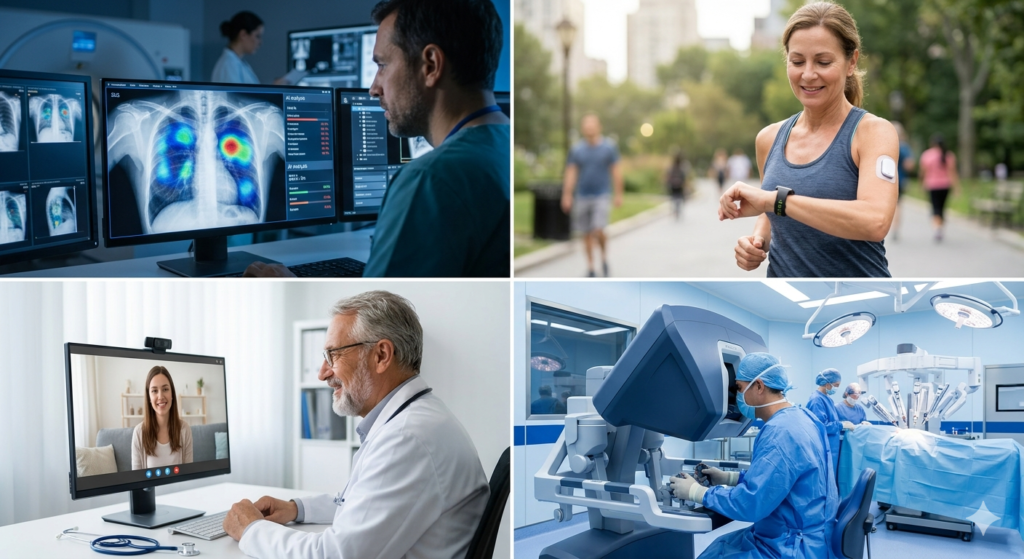
The Pillars of Digital Healthcare
Digital transformation is not a singular event but a convergence of several high-tech pillars. These technologies work in tandem to create a “smart” healthcare ecosystem that is more efficient, personalized, and accessible.
1. Artificial Intelligence and Machine Learning
Artificial Intelligence (AI) is perhaps the most transformative force in modern medicine. By processing vast amounts of data at speeds impossible for humans, AI assists in early diagnosis and personalized treatment plans.
- Diagnostic Imaging: AI algorithms can now detect anomalies in X-rays, MRIs, and CT scans with accuracy levels that often rival or exceed senior radiologists
- Predictive Analytics: Hospitals use machine learning to predict patient deterioration or the likelihood of readmission, allowing for proactive intervention.
2. The Internet of Medical Things (IoMT)
The Internet of Medical Things refers to a network of medical devices and applications that connect to healthcare IT systems via the internet. This includes everything from smart insulin pumps to wearable fitness trackers.
3. Telemedicine and Virtual Care
The global pandemic acted as a catalyst for telemedicine, proving that many medical concerns could be addressed remotely. This shift has democratized access to specialists, particularly for those living in rural or underserved areas.
Revolutionizing Patient Experience Through Data
At the heart of digital transformation is Data. Historically, medical data was siloed in paper files or disconnected hospital databases. Today, the move toward interoperability is putting the power back into the hands of both doctors and patients.
Big Data and Population Health Management
By analyzing data across large populations, healthcare providers can identify trends and health risks before they become crises. For instance, data can track the spread of an infectious disease in real-time or identify a spike in chronic respiratory issues in a specific geographic area due to environmental factors.
Electronic Health Records (EHRs)
The transition to cloud-based EHRs ensures that a patient’s medical history—allergies, past surgeries, and medication lists—is available to any authorized provider at any time. This reduces medical errors caused by incomplete information and eliminates the need for redundant testing.
Personalized Medicine and Genomics
We are moving away from the “one-size-fits-all” approach to medicine. Digital transformation enables Pharmacogenomics, where doctors can use a patient’s genetic profile to determine which medications will be most effective and which might cause adverse reactions.
The Role of Robotics and Advanced Surgery
Surgery has seen a radical upgrade thanks to digital integration. Robotic-assisted surgery allows for precision that human hands simply cannot match, leading to smaller incisions, less blood loss, and faster recovery times.
Minimal Invasive Procedures
Robotic systems, such as the Da Vinci Surgical System, provide surgeons with a high-definition, 3D view of the surgical site. The instruments can rotate 360 degrees, allowing for maneuvers in tight spaces that were previously unreachable without major open surgery.
Remote Surgery (Telesurgery)
With the advent of 5G technology, the latency (delay) in data transmission has dropped significantly. This opens the door for “telesurgery,” where a specialist in one part of the world can operate on a patient in another using a robotic interface.
Challenges in the Digital Frontier
While the benefits are immense, the road to a fully digital healthcare system is paved with significant challenges that must be addressed to ensure safety and equity.
Data Privacy and Cybersecurity
Healthcare data is incredibly sensitive and highly valuable on the black market. As hospitals become more connected, they also become bigger targets for ransomware attacks. Ensuring robust encryption and strict adherence to regulations like HIPAA (Health Insurance Portability and Accountability Act) is non-negotiable.
The Digital Divide
There is a growing concern that digital transformation could leave vulnerable populations behind. Not everyone has access to high-speed internet or the latest smartphone.
- Socioeconomic Barriers: Low-income families may struggle to afford wearable devices.
- Age Gaps: Older generations may find it difficult to navigate complex patient portals.
Interoperability Issues
Despite the tech, many systems still don’t “talk” to each other. A patient’s data at a private clinic might not seamlessly transfer to a state hospital. Establishing universal standards for data exchange is a primary goal for the next decade.
The Impact on Healthcare Professionals
Digital transformation isn’t just about the patients; it’s about the people providing the care. The “Burnout Crisis” among doctors and nurses is a significant threat to global health, and technology offers a potential solution.
Reducing Administrative Burden
Natural Language Processing (NLP) can now be uysed to scribe notes during patient visits. Instead of spending hours typing into a computer, doctors can focus on the human being sitting in front of them.
Enhanced Training via VR and AR
Virtual Reality (VR) is being used to train the next generation of surgeons. Medical students can perform a “surgery” hundreds of times in a virtual environment before ever touching a human patient, significantly flattening the learning curve.
Digital Healthcare Transformation Comparison Table
| Traditional Healthcare | Digital Healthcare |
|---|---|
| Paper medical records | Electronic health records |
| Long hospital waiting times | Faster online appointments |
| Manual diagnosis support | AI-powered diagnosis |
| In-person consultations only | Telemedicine and video calls |
| Limited patient monitoring | Real-time remote monitoring |
| Slow data sharing | Instant digital access |
| Higher paperwork | Automated healthcare systems |
| Less personalized treatment | Data-driven personalized care |
Future Outlook: What Lies Ahead?
The future of healthcare looks increasingly “phygital”—a blend of physical care and digital convenience.
The Rise of Bio-Printing
We are approaching a future where we may no longer need organ donor lists. Researchers are using 3D printing technology with “bio-ink” to create tissues and, eventually, functioning organs like kidneys or hearts tailored to a patient’s own DNA.
Nanotechnology in Treatment
Imagine “smart pills” or nanobots that can be injected into the bloodstream to deliver medicine directly to a tumor, sparing the rest of the body from the toxic effects of chemotherapy. This level of precision is the ultimate goal of the digital medical revolution.
Hospital-at-Home Models
The hospital of the future might not be a building at all. With advanced remote monitoring, many patients who currently require a hospital bed could be treated in the comfort of their own homes. Sensors under the mattress, wearable EKGs, and daily video check-ins ensure they receive hospital-level care without the risk of hospital-acquired infections.
| Healthcare Technology | How It Helps | Future Impact |
|---|---|---|
| Artificial Intelligence (AI) | Helps doctors diagnose diseases faster | Better and more accurate treatments |
| Telemedicine | Online doctor consultations | Easier healthcare access from home |
| Electronic Health Records (EHR) | Stores patient medical data digitally | Faster and organized patient care |
| Wearable Health Devices | Tracks heart rate, sleep, and fitness | Early health problem detection |
| Robotic Surgery | Supports precise surgical procedures | Safer and faster surgeries |
| Cloud-Based Healthcare | Secure online medical data storage | Easy data sharing between hospitals |
| Internet of Things (IoT) | Connects smart medical devices | Real-time patient monitoring |
| Big Data Analytics | Analyzes healthcare information | Improved decision-making in hospitals |
| Mobile Health Apps | Provides health tracking and reminders | Better patient engagement |
| Virtual Reality (VR) in Healthcare | Used for training and therapy | Advanced medical education and recovery |
Conclusion
Digital transformation in healthcare is more than just a trend; it is a necessary evolution. As the global population ages and the prevalence of chronic diseases rises, our traditional systems will no longer be sustainable. By embracing AI, the IoMT, and data-driven insights, we can shift from a system that treats sickness to one that actively maintains wellness.
However, as we move forward, we must ensure that the “human” element of medicine remains at the center. Technology should serve as a bridge, not a barrier, between the patient and the provider. The future of healthcare is bright, interconnected, and—most importantly—focused on delivering better outcomes for everyone, everywhere.
FAQ Questions
1. What is digital transformation in healthcare?
Digital transformation in healthcare means using modern technology like AI, telemedicine, electronic health records, and smart devices to improve patient care and hospital services.
2. How is AI helping the healthcare industry?
AI helps doctors diagnose diseases faster, improve treatment plans, reduce errors, and provide better patient care through smart medical systems.
3. What are the benefits of telemedicine?
Telemedicine allows patients to consult doctors online, saves travel time, reduces healthcare costs, and improves access to medical services.
4. What is the future of healthcare technology?
The future of healthcare includes AI-powered hospitals, robotic surgeries, wearable health devices, personalized medicine, and faster digital healthcare services.
5. Why are electronic health records important?
Electronic health records help doctors access patient information quickly, improve treatment accuracy, and reduce paperwork in hospitals.
6. How does digital healthcare improve patient experience?
Digital healthcare provides faster appointments, online consultations, better monitoring, and easier access to medical records for patients.
7.What are smart hospitals?
Smart hospitals use advanced technologies like AI, IoT devices, automation, and digital systems to improve healthcare efficiency and patient safety.
8. Is digital healthcare safe and secure?
Most healthcare systems use advanced cybersecurity and data protection methods to keep patient information safe and secure.