Meta Title
AI in the Finance Sector: Transforming the Future of Banking and Money Management
Meta Description
Discover how Artificial Intelligence is changing the finance sector. Learn how AI improves banking, fraud detection, customer service, investing, and money management in simple English.
Introduction
Artificial Intelligence (AI) is changing the world, and the finance sector is one of the biggest beneficiaries. From banking and investing to fraud detection and customer service, AI is making financial services faster, smarter, and more secure.
In simple words, AI allows computers and machines to think, learn, and make decisions like humans. In finance, this technology helps companies analyze huge amounts of data, identify patterns, and provide better services to customers.
This article will explain how AI is revolutionizing the finance industry, its benefits, challenges, applications, and future opportunities.
What is Artificial Intelligence in Finance?
Artificial Intelligence in finance refers to the use of advanced computer systems that can perform tasks such as:
- Learning from data
- predict market tools
- detecting fraud
- Automating processes
- provide financial advice
Financial institutions like banks, insurance companies, and investment firms use AI to improve efficiency and customer satisfaction.
Why AI is Important in Finance
The finance industry handles massive amounts of data every second. Human employees alone cannot process all this information quickly.
AI help by :
- analyzing large dataset instantly
- Reduce human errors
- Improving decesion macking
- Detecting suspicious activity
- offering personalized services
As competition increases, financial companies rely on AI to stay ahead.


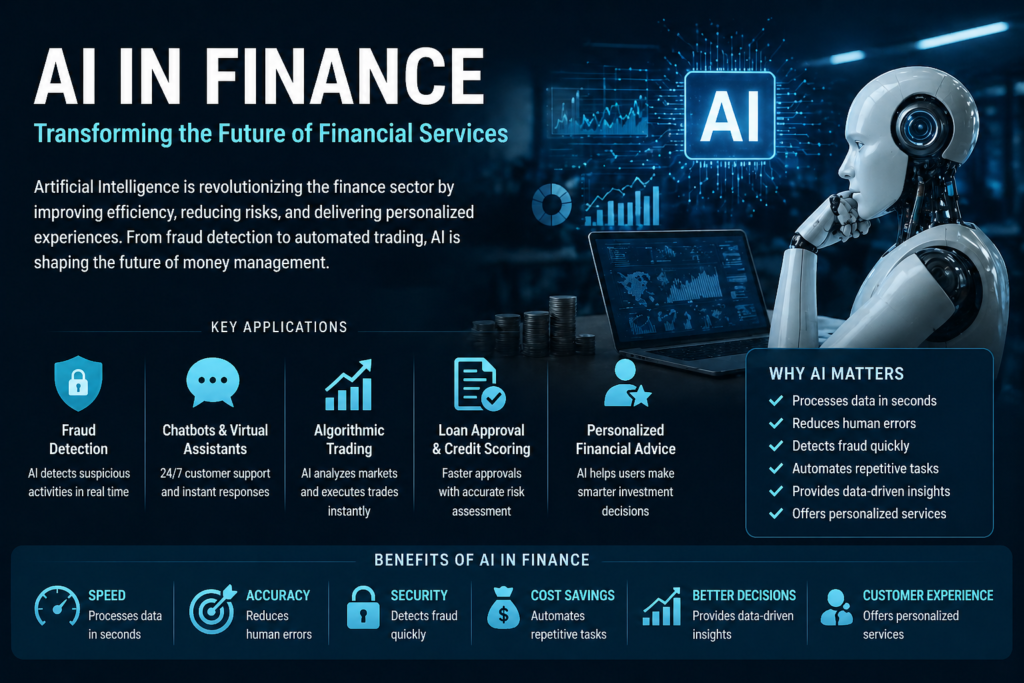
Major Applications of AI in Finance
1. Fraud Detection
Fraud is a major concern in the financial world. AI systems can monitor transactions in real time and identify unusual behavior.
For example, if your credit card is suddenly used in another country, AI can immediately flag the transaction.
Benefits included :
- Faster fraud detection
- Reduce financial losses
- Better customer protection
2. Chatbots and Virtual Assistants
Many banks now use AI-powered chatbots to assist customers 24/7.
These chatbot can:
- check account balance
- Transfer money
- Answer common questions
- Provide loan information
This improves customer service while reducing operational costs.
3. Algorithmic Trading
AI is widely used in stock markets for automated trading.
AI algorithm can :
- Analyzing market trends
- Execute trades instantly
- Reduce emotional decesion macking
- Maximize profits
High-frequency trading firms heavily depend on AI.
4. Credit Scoring and Loan Approval
Traditional loan approvals can take days. AI speeds up the process by analyzing:
- Credit history
- Income
- Spending habits
- Repayment behaviour
This enables faster and more accurate lending decisions.
5. Personalized Financial Advice
Robo-advisors use AI to offer investment recommendations.
They user help :
- Build portfolio
- Manage risk
- Plan retirement
- Achive finance goal
These services are affordable compared to traditional financial advisors.
Benefits of AI in Finance
| Benefit | Description |
|---|---|
| Speed | Processes data in seconds |
| Accuracy | Reduces human errors |
| Security | Detects fraud quickly |
| Cost Savings | Automates repetitive tasks |
| Better Decisions | Provides data-driven insights |
| Customer Experience | Offers personalized services |
How bank use AI :
Banks are among the biggest users of AI technology.
Common uses include:
- Customar support chatbot
- Fraud prevention
- loan processing
- Risk assessment
- Personalized offers
- Document verification
AI helps banks serve customers more efficiently while cutting costs.
AI in investment management
Investment firms use AI to analyze financial markets.
AI can examine:
- Historical stock data
- Company performance
- Economics indicator
- News sentiments
- social media trends
This helps investors make smarter decisions.
Popular robo-advisors like Wealthfront and Betterment use AI extensively.
AI in insurance
Insurance companies also benefit from AI.
Aplication included :
- Claim processing
- Risk assesment
- Fraud detection
- Customer support
- Premium calculation
AI can review claims much faster than human agents.
Risk management with AI
Financial institutions face many risks, including:
- Credit risk
- Market risk
- Operational risk
- cybersecurity threats
AI models can predict potential problems before they occur, helping companies take preventive action.
Real world example of AI in finance
Jpmorgan chase :
Uses AI for :
- Contract analysis
- faud detection
- trading strategies
Paypal
Employs AI to detect fraudulent transactions instantly.
Mastercard
Uses machine learning to improve payment security.
Goldman sachs
Applies AI in investment research and trading.
Challanges of AI in finance
Despite its many advantages, AI also has some challenges.
1.data privacy
Financial data is highly sensitive. Companies must ensure customer information remains secure.
2.High implementation cost
Developing AI systems can be expensive, especially for smaller firms.
3.Bias in algorithm
Poorly trained AI models can produce unfair results.
4.Regular complaint
Financial institutions must follow strict regulations when using AI.
5.cybersecurity risk
AI systems themselves can become targets for hackers.
The role of machine learning
Machine Learning (ML) is a branch of AI.
It allows systems to improve over time by learning from data.
In finance, ML is uses for :
- Predicting stock price
- Identifying fraud pattern
- customar segmentation
- credit risk analysis
The more data the system receives, the smarter it becomes.
AI and Blockchain
AI and blockchain together create powerful financial solutions.
Benefit included :
- Enhanced security
- Faster transaction
- Better fraud prevention
- Improving transparency
Many fintech companies are exploring this combination.
Future of AI in finance
The future looks incredibly promising.
Emerging trends include:
- Hyper-personalized banking
- Voice-enabled financial services
- AI-powered wealth management
- Advanced cybersecurity systems
- Automated compliance monitoring
AI will continue to reshape the finance industry over the next decade.
Impact on job
AI will automate many repetitive tasks, but it will also create new opportunities.
New role included
- AI specialist
- data scientist
- machine learning engineer
- Financial technology expert
Employees will need to develop new digital skills.
AI for small finance business
AI is no longer limited to large banks.
Small businesses can use AI for:
- Accounting management
- Expenses tracking
- customer support
- fraud monitor
- financial forecasting
Cloud-based AI solutions make adoption easier and more affordable.
Ethical Considerations
Responsible AI usage is essential.
Financial institutions must ensure:
- Transparency
- Fairness
- Accountability
- Privacy protection
Customers should understand how AI decisions are made.
Key Technologies Behind AI in Finance
- Machine Learning
- Natural Language Processing (NLP)
- Robotic Process Automation (RPA)
- Deep Learning
- Predictive Analytics
These technologies work together to improve financial services.
AI vs Traditional Finance Methods
| Feature | Traditional Methods | AI-Powered Methods |
|---|---|---|
| Processing Speed | Slow | Instant |
| Accuracy | Moderate | High |
| Fraud Detection | Reactive | Proactive |
| Customer Service | Limited Hours | 24/7 |
| Investment Advice | Expensive | Affordable |
How Consumers Benefit
Customers enjoy many advantages, such as:
- Faster loan approvals
- Better security
- Personalized offers
- Lower fees
- 24/7 support
- Improved financial planning
AI makes financial services more convenient and accessible.
Fintech and AI
Fintech companies are leading AI innovation.
They use AI for:
- Digital payments
- Lending
- Budgeting apps
- Cryptocurrency trading
- Automated investing
This competition pushes traditional banks to innovate.
Steps to Implement AI in Finance
- Identify business needs.
- Collect quality data.
- Choose the right AI tools.
- Ensure regulatory compliance.
- Train employees.
- Monitor performance regularly.
Successful implementation requires careful planning.
Conclusion
Artificial Intelligence is transforming the finance sector in remarkable ways. It improves efficiency, enhances security, reduces costs, and delivers better customer experiences.
From fraud detection and automated trading to personalized financial advice, AI is becoming an essential part of modern finance.
Although challenges like privacy, bias, and regulation remain, the benefits far outweigh the risks. Financial institutions that embrace AI today will be better prepared for the future.
As technology continues to evolve, AI will play an even greater role in shaping the financial world. For businesses, investors, and consumers alike, the future of finance is intelligent, automated, and incredibly exciting.
Frequently Asked Questions (FAQ)
1. What is AI in finance?
AI in finance means using artificial intelligence technology to automate and improve banking, investing, security, and financial services.
2. How does AI help banks?
AI helps banks with fraud detection, customer service, loan approval, and risk management.
3. Is AI safe for online banking?
Yes, AI improves banking security, but users should still use strong passwords and security features.
4. What are robo-advisors?
Robo-advisors are AI-powered platforms that provide automatic investment advice and portfolio management.
5. Can AI predict the stock market?
AI can analyze trends and data to make predictions, but stock markets are unpredictable and risky.
6. What are the benefits of AI in finance?
Main benefits include faster services, lower costs, improved accuracy, and better customer experiences.
7. Will AI replace financial jobs?
AI may automate some jobs, but human financial experts are still important for complex decision-making.
8. What is the future of AI in banking?
The future includes smarter banking apps, advanced fraud protection, personalized services, and automated financial management.