Meta Title
10 Best SaaS Tools for Business Growth in 2026 | Top Business Software Guide
Meta Description
Discover the 10 best SaaS tools for business growth in 2026. Compare CRM, marketing, automation, communication, and project management software with features, benefits, and FAQs.
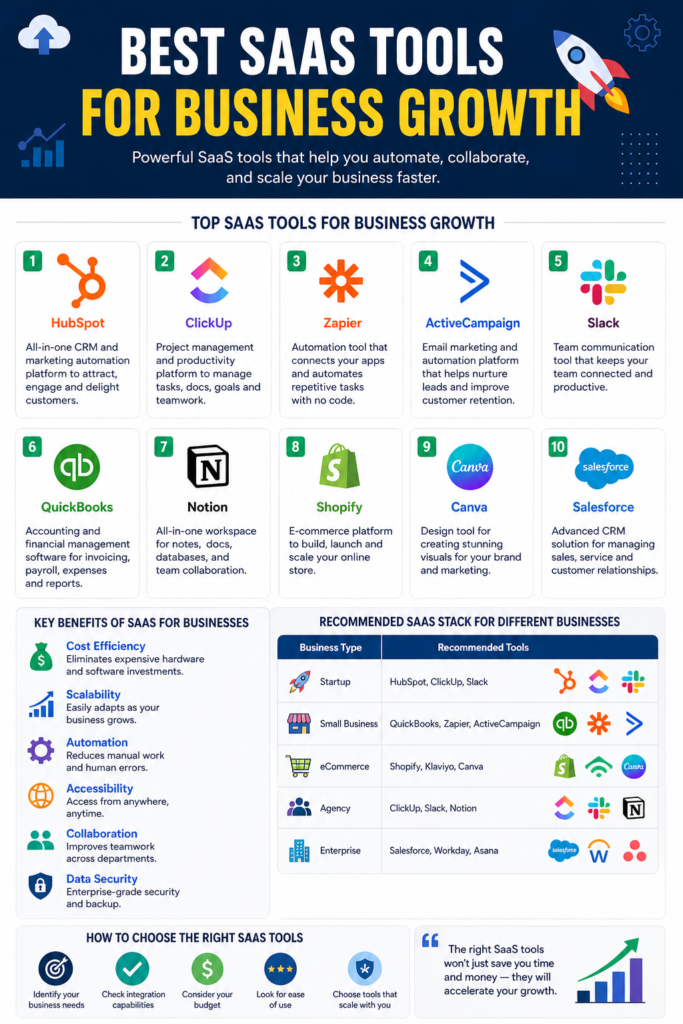
In today’s fast-moving digital economy, businesses need more than just hard work to succeed. They need smart tools that can automate tasks, improve productivity, and help teams collaborate effectively. This is where Software as a Service (SaaS) comes into play. SaaS tools have become essential for businesses of all sizes, from startups to large enterprises. They offer cloud-based solutions that are affordable, scalable, and accessible from anywhere in the world.
Whether you want to streamline operations, boost sales, improve customer relationships, or manage your finances, the right SaaS tools can significantly accelerate your business growth. Instead of investing heavily in expensive software and infrastructure, companies can subscribe to SaaS platforms and gain immediate access to powerful features.
In this comprehensive guide, we will explore the best SaaS tools for business growth in 2026, their key features, benefits, and how they can help your company thrive in a competitive marketplace.
What Are SaaS Tools?
Software as a Service (SaaS) refers to cloud-based software applications that users access through the internet. Unlike traditional software, SaaS products do not require installation on individual computers. Users simply log in through a web browser or mobile app.
SaaS tools offer several advantages:
- Lower upfront costs
- Automatic updates
- Easy scalability
- Remote accessibility
- Enhanced security
- Better team collaboration
These benefits make SaaS solutions ideal for modern businesses.
Why SaaS Tools Are Important for Business Growth
Businesses today face numerous challenges, including increasing competition, changing customer expectations, and the need for operational efficiency. SaaS tools help solve these problems by automating repetitive tasks and improving decision-making.
Key Benefits of SaaS for Businesses
| Benefit | Description |
|---|---|
| Cost Efficiency | Eliminates expensive hardware and software investments. |
| Scalability | Easily adapts as your business grows. |
| Automation | Reduces manual work and human errors. |
| Accessibility | Access from anywhere, anytime. |
| Collaboration | Improves teamwork across departments. |
| Data Security | Enterprise-grade security and backup. |
Best SaaS Tools for Business Growth
1. HubSpot
HubSpot is one of the most popular all-in-one business platforms available today. It combines customer relationship management (CRM), marketing automation, sales tools, and customer service into a single platform.
HubSpot helps businesses attract visitors, convert leads, and retain customers. Its intuitive interface makes it ideal for both beginners and experienced marketers.
Key feature
- Free CRM
- Email marketing automation
- sales pipeline management
- customar support ticketing
- AI powered contant tools
- Detailed analysis
Best for
Small businesses, startups, and growing enterprises.
2. Salesforce
Salesforce is the global leader in CRM software. It provides advanced customer relationship management tools designed for businesses that want to scale rapidly.
Salesforce enables companies to manage sales, marketing, customer support, and analytics from one centralized dashboard.
Key features
- Lead management
- sales forecasting
- workflow automation
- customar analysis
- App marketing
- AI Insights with Einstein AI
Best for
Medium to large enterprise
3.click up
ClickUp is an all-in-one project management and productivity platform. It helps teams organize tasks, manage projects, and collaborate efficiently.
Many businesses replace multiple tools with ClickUp because of its versatility.
Key features:
- Task management
- Time tracking
- Team collaboration
- workflow automation
- Document sharing
- Goal setting
Best for
Remote terms, agencies, and startup
4.slack
Slack has transformed workplace communication. It replaces endless email chains with organized conversations.
Teams can create channels for projects, departments, and clients while integrating other business tools.
Key features
- Instant messaging
- File sharing
- voice and video call
- App integration
- workflow automation
- searchable conversation
Best for
Business of all sizes.
5.zapier
Zapier is one of the most powerful automation tools available. It connects thousands of apps and automates workflows without coding.
For example, when someone fills out a form, Zapier can automatically add them to your CRM and send a follow-up email.
Key features.
- No code automation
- 6000 + integration
- Multi-step workflow
- condition logic
- AI-powerd automation
Best for
Business looking save time .
6.Quickbook online
Financial management is crucial for business growth. QuickBooks Online simplifies accounting, invoicing, payroll, and tax preparation.
It is widely used by small businesses and accountants worldwide.
Key features
- Expense tracking
- Invoicing
- payroll management
- Tax calculation
- Financial report
- Bank reconciliation
Best for
small and medium businesses.
7.shopify
For eCommerce businesses, Shopify is an industry-leading platform. It allows companies to build, manage, and scale online stores.
Its simplicity and extensive app ecosystem make it highly popular.
Key Features
- Online store builder
- payment processing
- inventory management
- Marketing tools
- Mobile commerce
- Analysis dashboard
Best for
Online retailers and DTH brads.
8.Notion
Notion combines note-taking, documentation, project management, and databases into one flexible platform.
Businesses use it for knowledge management, SOPs, and team collaboration.
Key features
- Notes and docs
- Team wiki
- Databases
- Task management
- Templates
- AI writing assistant
Best for
Content teams and knowledge workers.
9.canva
Visual content is essential for modern marketing. Canva makes professional graphic design accessible to everyone.
Businesses use Canva for social media graphics, presentations, ads, and branding materials.
Key features
- Drag and drop editor
- Thousands of temples
- Brads kit
- Video editing
- AI image generator
- Team collaboration
Best for
Marketing teams and entrepreneurs.
10.Activecampaing
ActiveCampaign excels in email marketing and customer automation.
It helps businesses nurture leads, improve retention, and increase customer lifetime value.
Key features
- Email automation
- Customer segmentation
- CRM integration
- Predictive sending
- Detailed reporting
Best for
Businesses focused on customer engagement.
Have to choose the right saas Tools
Selecting the right SaaS tools requires careful consideration. Not every tool will fit every business.
Factors to consider
- Business size
- Budge
- Required features
- Integration capabilities
- Easy of use
- Customer support
- scalability
Always start with your biggest pain points and choose tools that solve them.
Recommended SaaS Stack for Different Businesses
| Business Type | Recommended Tools |
|---|---|
| Startup | HubSpot, ClickUp, Slack |
| Small Business | QuickBooks, Zapier, ActiveCampaign |
| eCommerce | Shopify, Klaviyo, Canva |
| Agency | ClickUp, Slack, Notion |
| Enterprise | Salesforce, Workday, Asana |
Common mistake to avoid
Many businesses make costly mistakes when adopting SaaS.
Avoid this Errors
- Buying to many tools
- Ignoring integration capabilities
- Overlooking employee training
- Not reviewing ROI regularary
A smaller, well-integrated tech stack often performs better than a large, complicated one.
Future trends in saas
The SaaS industry continues to evolve rapidly.
Emerging trends
- AI powered automation
- Vertical saas solution
- Enhance cybersecurity
- Lowe code and no code platform
- Advance analytics
- Personalized customer experience
Businesses that adopt these innovations early will gain a competitive advantage.
Comparison table
| Feature | Traditional Software | SaaS Tools |
|---|---|---|
| Installation | Manual setup | Cloud-based access |
| Updates | Manual updates | Automatic updates |
| Accessibility | Limited devices | Access anywhere |
| Cost | High upfront cost | Subscription-based |
| Scalability | Difficult | Easy scaling |
| Maintenance | User-managed | Provider-managed |
Final thoughts
SaaS tools have become the backbone of modern business growth. They help organizations automate operations, improve efficiency, and scale faster than ever before.
Whether you are launching a startup, running a small business, or managing an enterprise, investing in the right SaaS solutions can transform your operations and unlock new growth opportunities.
If you are just getting started, focus on essential categories:
- CRM: hubspot and Salesforce
- Project management: Clickup
- Communication: slack
- Automation: zapier
- Accounting : Quickbook
- Marketing: Activecampaing
- Design: canva
The goal is not to use the most tools, but to use the right tools effectively.
As technology continues to evolve, SaaS will remain a critical driver of innovation, productivity, and profitability. Businesses that embrace these solutions today will be better prepared for tomorrow’s challenges.
Start small, scale wisely, and let SaaS power your business growth journey.
10 Best saas Tools for business growth 2026
| SaaS Tool | Main Purpose | Key Features | Business Benefit |
|---|---|---|---|
| Slack | Team Communication | Chat, channels, integrations | Faster collaboration |
| HubSpot | CRM & Marketing | Email marketing, CRM, automation | Better lead management |
| Shopify | eCommerce Platform | Online store builder, payments | Easy online selling |
| Zoom | Video Meetings | HD meetings, webinars | Remote communication |
| Notion | Productivity & Notes | Workspace, docs, task management | Better organization |
| Trello | Project Management | Boards, task tracking | Improved workflow |
| Canva | Design Tool | Templates, AI design tools | Quick content creation |
| Zapier | Workflow Automation | App integrations, automation | Saves time and effort |
| Salesforce | Customer Relationship Management | Analytics, automation, CRM | Business scalability |
| Google Workspace | Cloud Productivity | Docs, Sheets, Meet, Drive | Team productivity |
FAQ Section
1. What are SaaS tools?
SaaS tools are cloud-based software applications that users can access through the internet without installing them on local computers.
2. Why are SaaS tools popular in 2026?
They offer flexibility, automation, remote accessibility, and cost-effective solutions for businesses of all sizes.
3. Which SaaS tool is best for startups?
Tools like Slack, Notion, Canva, and Shopify are popular choices for startups because they are easy to use and scalable.
4. How do SaaS tools help business growth?
They improve productivity, automate workflows, enhance communication, and simplify customer management.
5. Are SaaS tools secure?
Most leading SaaS companies use advanced security measures such as encryption, cloud backups, and multi-factor authentication.