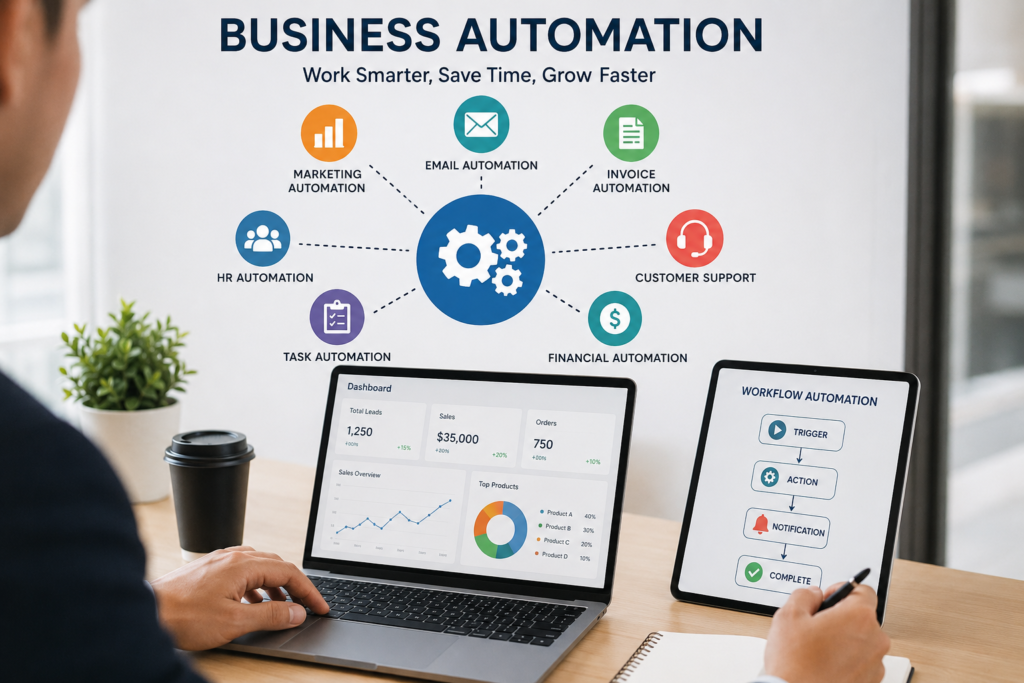
Business Automation Software: Benefits, Features, Tools & Best Solutions in 2026
Learn everything about Business Automation Software, including benefits, features, top tools, pricing, and implementation tips. Discover how automation helps businesses save time, reduce costs, and increase productivity.
Business Automation Software: Complete Guide for Modern Businesses
Introduction
In today’s fast-moving digital world, businesses must work smarter to stay competitive. Companies handle many daily tasks such as customer support, marketing, sales, accounting, human resources, and inventory management. Doing these tasks manually takes time and increases the chance of mistakes.
This is where Business Automation Software becomes important.
Business automation software helps organizations automate repetitive tasks, improve productivity, reduce costs, and increase efficiency. Whether you run a small business, startup, or large enterprise, automation can help your company grow faster.
This guide explains everything you need to know about business automation software in simple English.
What is Business Automation Software?
Business Automation Software is a digital tool that automates routine business processes and workflows without requiring manual effort.
Instead of employees spending hours on repetitive tasks, the software performs those tasks automatically based on predefined rules.
Examples of Automated Tasks
- Sending emails
- Generating invoices
- Managing customer data
- Tracking inventory
- Employee onboarding
- Payroll processing
- Appointment scheduling
- Social media posting
- Report generation
Automation allows employees to focus on important activities that require human creativity and decision-making.
Why Business Automation Matters
Modern businesses generate huge amounts of data and perform thousands of tasks daily.
Manual processes often lead to:
- Human errors
- Delays
- Higher costs
- Lost opportunities
- Reduced productivity
Automation solves these challenges by streamlining operations.
Key Benefits
| Benefit | Description |
|---|---|
| Time Saving | Reduces manual work |
| Higher Productivity | Employees focus on important tasks |
| Better Accuracy | Fewer human mistakes |
| Cost Reduction | Lower operational expenses |
| Faster Response | Improved customer experience |
| Scalability | Supports business growth |
| Better Reporting | Real-time business insights |
How Business Automation Software Works
Business automation software follows predefined workflows.
Basic Process
- A task is triggered.
- Software follows programmed rules.
- Actions are completed automatically.
- Results are recorded and reported.
Example
Customer fills out a contact form:
- Software captures customer information.
- Creates lead record.
- Sends welcome email.
- Notifies sales team.
- Schedules follow-up task.
Everything happens automatically.
Main Types of Business Automation Software
Businesses use different automation tools depending on their needs.
1. Marketing Automation
Marketing automation helps businesses attract and nurture customers.
Features
- Email marketing
- Lead generation
- Campaign management
- Social media scheduling
- Customer segmentation
Benefits
- Better customer engagement
- More qualified leads
- Increased sales
2. Sales Automation
Sales teams spend significant time on administrative work.
Sales automation simplifies:
- Lead tracking
- Follow-up reminders
- Proposal creation
- Pipeline management
- Customer communication
Benefits
- Faster sales process
- Improved conversion rates
- Better customer relationships
3. Customer Service Automation
Customer support automation improves customer satisfaction.
Features
- Chatbots
- Ticket management
- Self-service portals
- Automated responses
Benefits
- Faster support
- Reduced workload
- Improved customer experience
4. Accounting Automation
Accounting software automates financial tasks.
Automated Processes
- Invoicing
- Expense tracking
- Payroll
- Tax calculations
- Financial reporting
Benefits
- Accurate records
- Reduced accounting errors
- Faster financial management
5. Human Resources Automation
HR departments handle many repetitive tasks.
Automated Tasks
- Employee onboarding
- Attendance tracking
- Leave management
- Payroll processing
- Performance reviews
Benefits
- Improved employee experience
- Reduced paperwork
- Better compliance
6. Inventory Management Automation
Inventory automation tracks products automatically.
Features
- Stock monitoring
- Reorder alerts
- Barcode scanning
- Warehouse management
Benefits
- Reduced stock shortages
- Better inventory control
- Lower storage costs
Essential Features of Business Automation Software
When choosing software, look for these features.
| Feature | Importance |
|---|---|
| Workflow Automation | Core automation capability |
| Integration Support | Connects with other tools |
| Reporting Dashboard | Business insights |
| Cloud Access | Work from anywhere |
| Security Controls | Data protection |
| Mobile Access | On-the-go management |
| AI Features | Smart automation |
| Custom Workflows | Flexible processes |
Top Business Automation Software Solutions
1. HubSpot
Best for marketing and CRM automation.
Advantages
- Easy to use
- Strong automation tools
- Excellent reporting
Best For
Small and medium businesses
2. Salesforce
One of the most powerful business automation platforms.
Advantages
- Highly customizable
- Advanced CRM features
- Enterprise-grade functionality
Best For
Large organizations
3. Zoho One
Provides a complete business suite.
Advantages
- Affordable pricing
- Multiple integrated apps
- Strong automation tools
Best For
Growing businesses
4. Monday.com
Popular workflow automation platform.
Advantages
- Visual dashboards
- Team collaboration
- Custom workflows
Best For
Project management teams
5. Microsoft Power Automate
Microsoft’s automation solution.
Advantages
- Microsoft integration
- AI-powered workflows
- Enterprise features
Best For
Businesses using Microsoft products
Business Automation Software Comparison
| Software | Best For | Free Plan | Automation Features |
|---|---|---|---|
| HubSpot | Small Business | Yes | Excellent |
| Salesforce | Enterprise | No | Excellent |
| Zoho One | Growing Companies | No | Very Good |
| Monday.com | Project Teams | Limited | Good |
| Power Automate | Microsoft Users | Limited | Excellent |
Industries That Use Business Automation
Automation benefits almost every industry.
Healthcare
- Patient scheduling
- Billing
- Medical records
Retail
- Inventory management
- Customer communication
- Order processing
Manufacturing
- Production planning
- Supply chain automation
- Quality control
Education
- Student management
- Admissions
- Communication
Finance
- Reporting
- Compliance
- Fraud detection
How Business Automation Increases Productivity
Employees often spend hours on repetitive activities.
Automation can handle:
- Data entry
- Scheduling
- Reporting
- Notifications
- File management
As a result:
- Employees save time
- Projects move faster
- Customers receive quicker responses
This leads to higher productivity across the organization.
Common Challenges in Business Automation
While automation offers many benefits, businesses may face challenges.
Initial Cost
Some platforms require investment.
Solution
Start with affordable cloud-based solutions.
Employee Resistance
Workers may worry about automation.
Solution
Provide training and explain benefits.
Integration Issues
Some systems may not connect easily.
Solution
Choose software with strong integration support.
Security Concerns
Automation handles sensitive information.
Solution
Use secure software with encryption and access controls.
Future Trends in Business Automation
Automation continues evolving rapidly.
Artificial Intelligence
AI helps automate decision-making.
Machine Learning
Systems improve over time using data.
Robotic Process Automation (RPA)
Software robots perform repetitive digital tasks.
Predictive Analytics
Businesses can forecast future outcomes.
Hyperautomation
Combines AI, automation, and analytics into one system.
These trends will shape the future of business operations.
How to Choose the Right Business Automation Software
Follow these steps:
1. Identify Business Needs
Determine which processes need automation.
2. Set a Budget
Choose software that fits your budget.
3. Check Integrations
Ensure compatibility with existing tools.
4. Evaluate Security
Protect business data.
5. Test Free Trials
Try software before purchasing.
6. Consider Scalability
Choose a solution that grows with your business.
Best Practices for Successful Automation
- Start small
- Automate repetitive tasks first
- Train employees properly
- Monitor performance regularly
- Update workflows when needed
- Measure return on investment
Following these practices increases automation success.
Conclusion
Business Automation Software has become essential for modern organizations. It helps companies save time, reduce costs, improve productivity, and deliver better customer experiences.
Whether you operate a small startup or a large enterprise, automation can streamline operations and support long-term growth.
As technology continues advancing, businesses that embrace automation will gain a significant competitive advantage. Investing in the right business automation software today can help create a more efficient, profitable, and scalable business tomorrow.
Frequently Asked Questions (FAQs)
1. What is business automation software?
Business automation software is a tool that automates repetitive business tasks and workflows to improve efficiency and productivity.
2. Why do businesses use automation software?
Businesses use automation software to save time, reduce costs, improve accuracy, and increase productivity.
3. Is business automation software expensive?
Costs vary depending on features and business size. Many tools offer affordable plans for small businesses.
4. Which business automation software is best?
Popular options include HubSpot, Salesforce, Zoho One, Monday.com, and Microsoft Power Automate.
5. Can small businesses use automation software?
Yes. Many automation tools are designed specifically for startups and small businesses.
6. Does automation replace employees?
Automation reduces repetitive work but allows employees to focus on higher-value tasks requiring creativity and decision-making.
7. What industries benefit from automation?
Healthcare, retail, finance, manufacturing, education, logistics, and many other industries benefit from automation.
8. Is business automation secure?
Most modern automation platforms offer strong security features such as encryption, access controls, and compliance certifications.
9. How long does implementation take?
Implementation can take anywhere from a few days to several months depending on business complexity.
10. What is the future of business automation?
The future includes AI-powered automation, machine learning, robotic process automation, and hyperautomation technologies.